



When you purchase through our links, we may earn a commission at no extra cost to you. As an Amazon Associate, DreamSlumber earns from qualifying purchases. Learn more.
Memory foam is a type of viscoelastic polyurethane foam that is used in mattresses, pillows, or toppers to give you the ultimate comfort. It uses your body heat and pressure to create a slow-response surface that conforms to your shape. The material offers sleepers the benefits of pressure relief, but its dense structure can lead to heat retention at night.
You must have heard of the term “memory foam” while shopping for mattresses in the market. These surfaces have become popular among sleepers as they melt away pressure and dampen the motion exceptionally well. So, what is memory foam? This material is a special viscoelastic foam, which was developed by NASA. Today, it is used in mattresses, pillows, and mattress toppers to address the slumber needs of those suffering from nightly pain or overheating.
The memory foam pillows help align your neck, while toppers help you customize your current sleep surface. This guide will help you understand the science behind its construction and why it is the right choice for your wellness goals. So, keep reading to explore what is memory foam and how does it work, whether it is safe, its durability, and exactly who needs it.
What is Memory Foam, and How Does it Work?
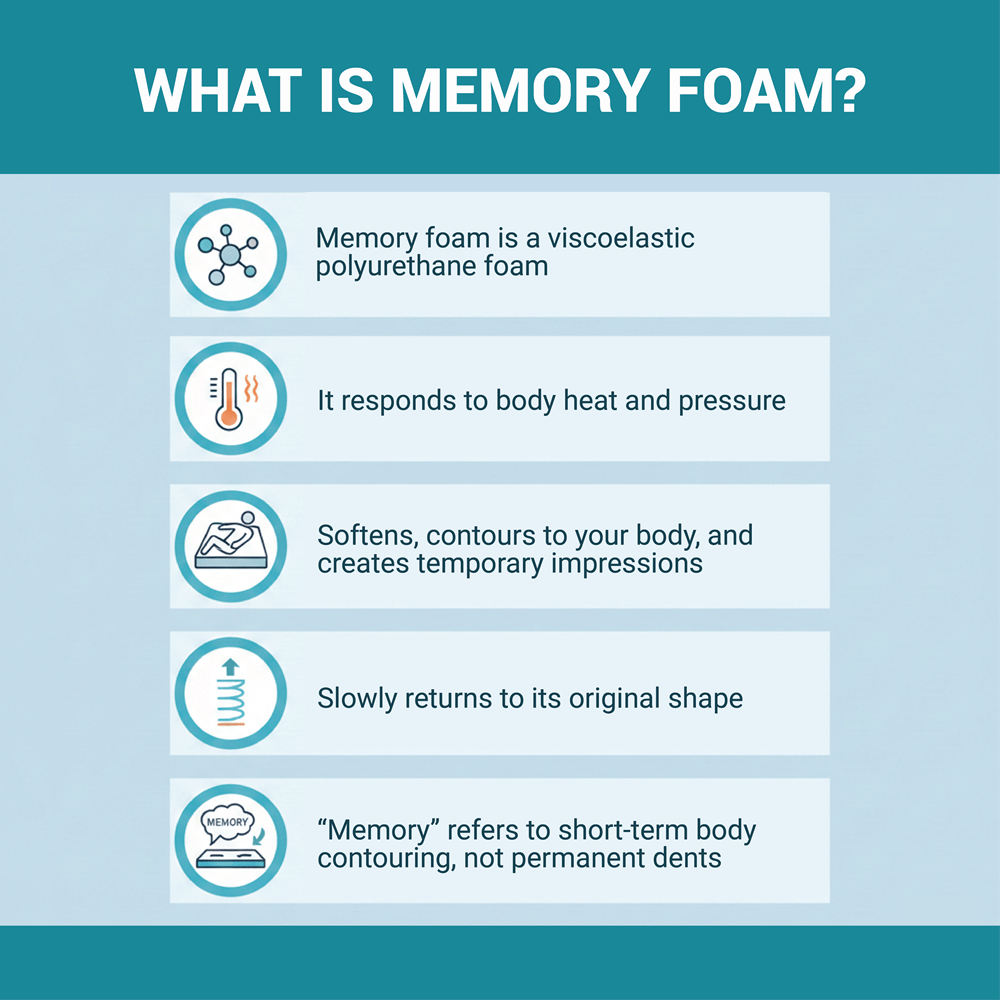
Memory foam softens when it absorbs body heat and pressure. It conforms to your body’s contours before slowly returning to its original shape once the pressure is removed. For this, it uses two characteristics, viscosity and elasticity, to adapt to your sleeping position. Let us discuss this process in detail:
What is Memory Foam?
The viscoelastic polyurethane foam responds to warmth and weight by becoming softer and more pliable. It displays both viscosity and elasticity in its working process. This means it flows slowly under load (like a viscous liquid) but eventually recovers its shape (due to the bounciness of elasticity). In memory foam, the term “memory” refers to the temporary body impressions the foam creates while you sleep on it. The foam does not make permanent dents that stay after you get up.
How Memory Foam Responds to Heat and Pressure
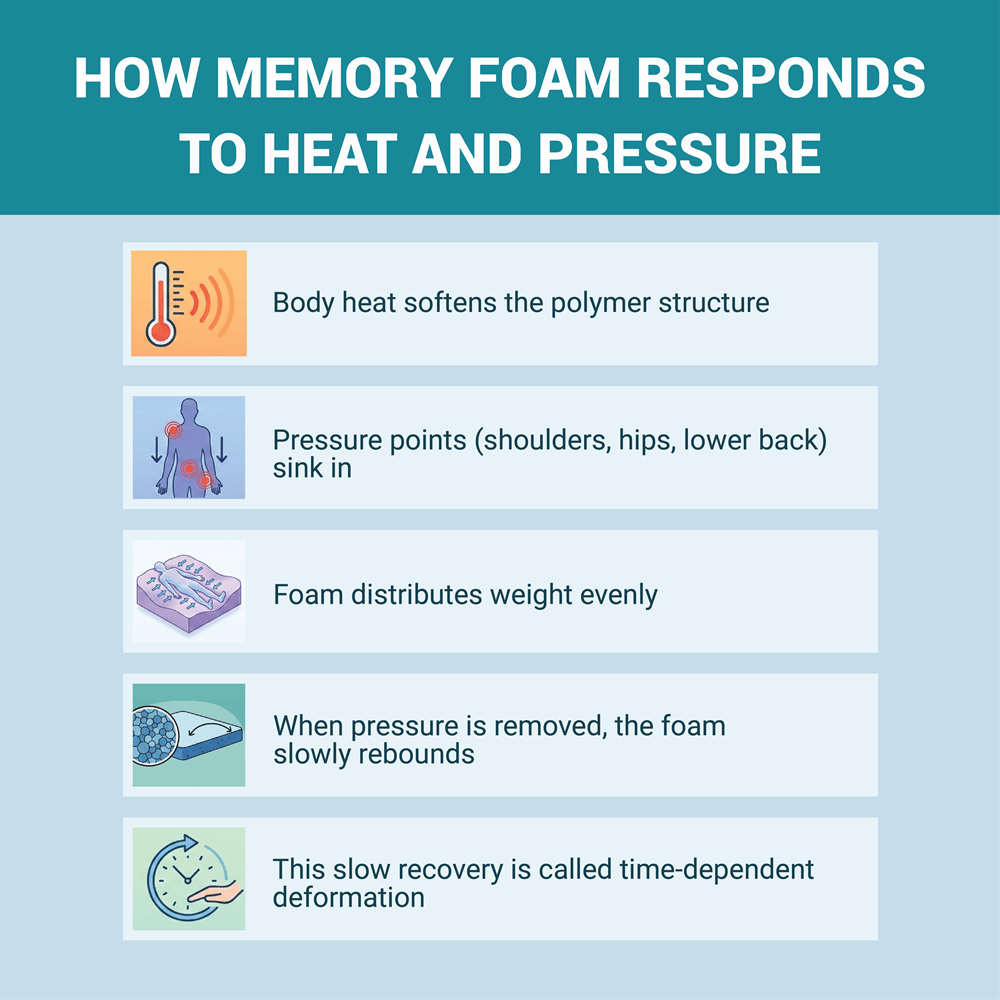
Your body heat softens the polymer structure at the points of contact with the memory foam surface. This makes the foam embrace your pressure points like your shoulders, hips, and lower back. Once you leave the surface, the foam slowly cools and rebounds, and the pressure also dissolves. This is a process called time-dependent deformation, which shows slow recovery in memory foam surfaces.
The Science in Simple Terms
Memory foam has an open-cell structure, and when weight is applied, its air pockets compress. This pushes the air out through the foam’s matrix. It flows slowly and molds to your body. This cellular architecture and the foam’s viscoelastic properties create the hugging sensation that relieves pressure while aligning your spine.
What is Memory Foam Made of and is it Safe? Composition, History, and Safety
Memory foam consists of polyurethane foam and infused chemicals that change its viscosity, density, and recovery time. It was developed by NASA in 1966 as “slow spring-back foam” for the safety of aircraft. Let us discuss its composition in detail:
Core Materials and Chemical Makeup
Memory foam uses two primary chemical components, which are polyols and isocyanates. Polyols are the building blocks. It provides hydroxyl groups that react with isocyanates through a process called polyaddition to form urethane bonds. Common isocyanates include:
- Toluene Diisocyanate (TDI), which creates soft and breathable foams
- Methylene Diphenyl Diisocyanate (MDI) offers better aging resistance and lower toxicity.
Catalysts like stannous octoate and additives such as surfactants and blowing agents help control the foaming reaction and final structure. This results in an open-cell structure, which promotes airflow through the foam. The denser formulations provide firmer support and longer durability.
From NASA to Your Bedroom
- In 1966, NASA sought to develop better cushioning for aircraft seats that could absorb impact and protect it from a crash. The result was a temperature-sensitive, viscoelastic polyurethane foam, called “temper foam” or “slow spring-back foam.” This material was used exclusively in aerospace applications.
- By the 1980s, NASA released the formula to the public domain, and companies began exploring medical uses like wheelchair cushions and hospital beds to prevent pressure sores.
- In 1991, Swedish company Fagerdala World Foams introduced the first memory foam mattress to consumers under the Tempur-Pedic brand.
Modern Formulations and Additives
Today’s memory foam comes in several formulations. These include traditional petroleum-based versions and plant-based foam. The plant-based variants use renewable bio-polyols derived from plant oils, reducing dependence on petroleum while maintaining performance. Additionally, many memory foams come with gel-, copper-, and graphite-infusion to address heat retention in memory foam.
Safety, Off-gassing, and Certifications
Memory foam off-gassing means that it releases volatile organic compounds (VOCs) when you first unpack a new mattress. This odor dissipates within a few hours or in a day, but some may take up to two weeks. Many safety certifications set standards so that memory foam products are safe to use, such as:
- CertiPUR-US Certification: Verifies that foam contains no ozone depleters, formaldehyde. It also checks if it is free from prohibited flame retardants like PBDEs, heavy metals, or regulated phthalates, and emits low VOCs.
- GREENGUARD Gold Certification: Sets limits on VOC emissions and over 360 individual chemicals, making it ideal for sensitive individuals, children, and those with respiratory conditions.
- OEKO-TEX Standard 100: Certifies that textiles and materials are free from harmful substances throughout the manufacturing process
Types of Memory Foam and How They Feel
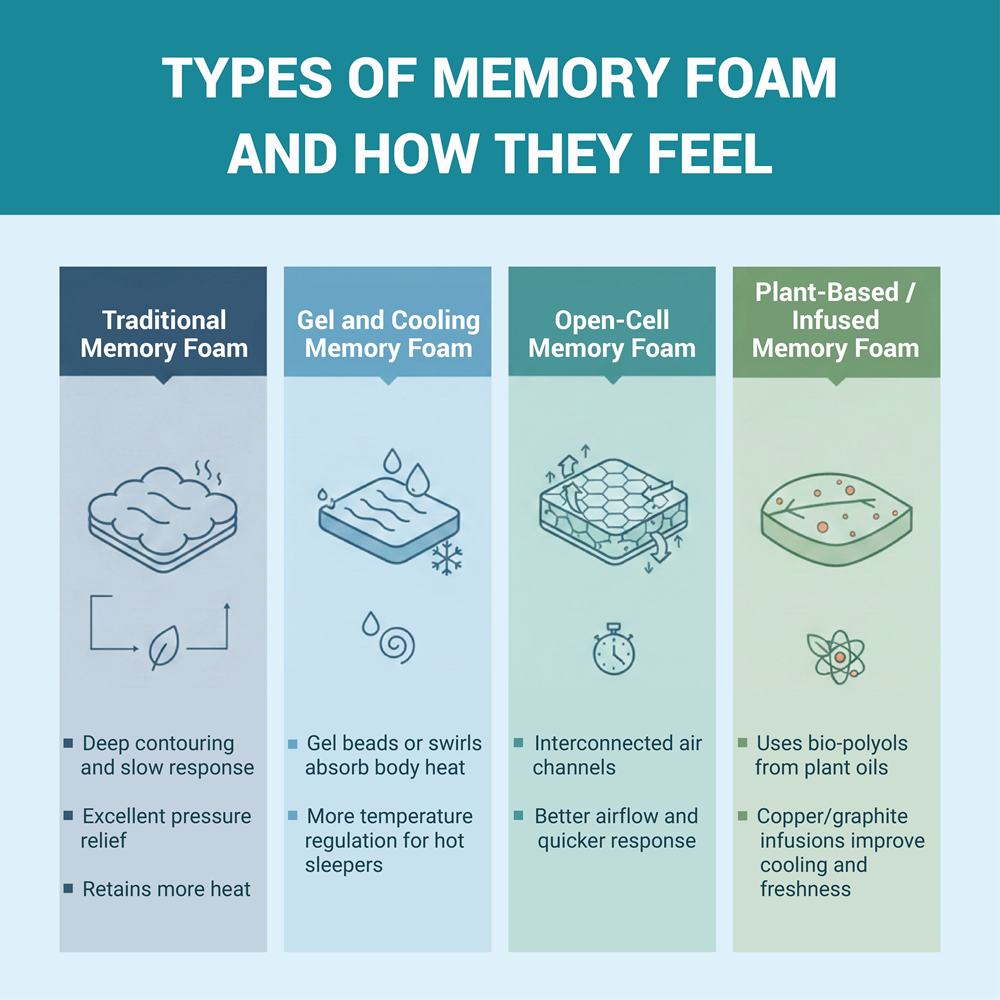
Memory foam comes in various formulations to address the needs and preferences of different sleepers. Each offers a slow and responsive feel, but their chemistry is slightly changed with additives to give targeted benefits. Let us discuss each type in detail:
Traditional Memory Foam
Traditional memory foam is designed to provide deep contouring and gradual responsiveness. This means it takes a few seconds to return to shape after you move. It gives excellent pressure relief and motion isolation, making it a best for couples and joint pain sufferers. If you’re shopping for options that highlight these benefits, explore our guide to the top-rated memory foam mattresses for different sleepers. However, its dense structure retains body heat, which can be an issue if you sleep hot.
Gel and “cooling” Memory Foams
To tackle the issue of overheating, manufacturers now use gel-infused memory foam to create the best type of memory foam for hot sleepers. If temperature regulation is your priority, our roundup of mattresses designed to sleep cooler at night breaks down the best-performing options. It uses gel beads, swirls, or liquid gel, which absorb and redistribute body heat. Some also use “phase change material” (PCM) that physically changes from solid to liquid at microscopic levels to regulate temperature actively.
Open-cell vs Closed-cell Constructions
Memory foam layers now include open-cell structures. This means they use tiny balloon-like cells inside the foam that are interconnected. Through these channels, air can flow easily when you move on the surface. These structures also wick away heat and moisture much better than older closed-cell designs, which trap air in sealed pockets.
Plant-based Memory Foam/Eco Memory Foams
These variants replace the petroleum-based oils (polyols) with plant-derived oils like soy, castor, or bamboo. Such bio-foams emit fewer VOCs and are more breathable than standard foams. While they may not be 100% natural (due to polyurethane), they are more eco-friendly than other variants.
Copper-, Graphite-, and Other Infused Foams
Some memory foams also come with conductive materials like copper or graphite. Copper-infused memory foam conducts heat away from your body faster than foam. Copper also has natural antimicrobial properties, which can help keep your mattress fresher. Similarly, graphite infusions use carbon structures to dissipate heat, offering better temperature regulation over standard foam.
Benefits and Drawbacks of Memory Foam in Everyday Use
If you are wondering if a memory foam mattress is a good choice for you, it depends on what qualities you prefer at night. They work as a perfect pressure relief and motion isolation mattress, but this does not mean it is for everyone. Let us discuss the pros and cons of memory foam mattresses in detail:
Benefits: What Memory Foam Does Well
- Pressure relief: The material displaces your weight evenly, reducing stress on heavy points like hips and shoulders. This makes it a good option for memory foam back pain relief and joint comfort.
- Motion isolation: If you share a bed, memory foam absorbs movement very well. This is why it’s often recommended in mattresses designed for couples who value uninterrupted sleep. You will not feel your partner getting up or moving around.
- Spinal alignment: By contouring to your specific shape, the foam fills the gap in your lumbar region (lower back). This helps keep your spine neutral.
| Pros | Why it matters | Best for |
| Pressure Relief | Displaces weight evenly to reduce pain in the hips/shoulders | Side sleepers & those with joint pain. |
| Motion Isolation | Absorbs movement so you don’t feel a partner move | Couples & light sleepers. |
| Spinal Alignment | Contours to natural curves, supporting the lower back | Back sleepers & chronic pain sufferers. |
| Hypoallergenic | Dense structure resists dust mites and allergens | Allergy sufferers. |
Drawbacks: Common Complaints And Trade-Offs
- Heat retention: Memory foam hugs your body, and it can trap heat. If you are a hot sleeper, look for cooling memory foam mattresses with gel or open-cell technology.
- “Stuck” feeling: The slow response time can make moving or rolling over difficult. The softer and high-density models are not ideal for people with mobility issues.
- Off-gassing: New mattresses give off a chemical smell when you unbox them. It is generally harmless and temporary.
- Edge support: All-foam mattresses lack reinforced edges. When sitting on the edge, you may feel unstable.
| Cons | When it shows up | Possible fixes |
| Heat Retention | During warm nights or for hot sleepers. | Choose gel or open-cell foam; use breathable sheets. |
| “Stuck” Feeling | When trying to roll over or get out of bed | Opt for responsive hybrid models or higher firmness. |
| Off-Gassing | First 24-72 hours after unboxing | Ventilate the room; choose CertiPUR-US® certified foam. |
| Edge Support | Sitting on the edge to put on shoes | Look for reinforced edges or high-density base foam. |
Durability, Sagging, And Lifespan
A memory foam mattress lifespan ranges from 6 to 10 years. To assess its longevity, you must look at memory foam density:
- Low Density (< 3.5 lbs/ft³): Lasts 5-6 years and is prone to softening and sagging.
- High Density (5+ lbs/ft³): Can last 8-12 years, and resists body impressions but costs more.
How a Memory Foam Mattress is Built
Most memory foam mattresses are engineered with distinct layers. They use a comfort layer on top, a transition layer in the middle, and a support core at the bottom. The thickness, density, and order of these layers dictate the bed’s feel and performance.
Typical Memory Foam Mattress Layers
- Comfort Layer: The top 2-4 inches of viscoelastic foam (gel, traditional, or plant-based) that contours to your body.
- Transition Layer: A slightly firmer foam that acts as a buffer, stopping you from sinking into the hard base. It helps with spinal support.
- Support Core: The thick base layer (6+ inches) is made of high-density poly-foam. It gives the mattress its structure and durability
All-Foam Vs Hybrid Memory Foam Designs
An all-foam mattress uses foam cores for support, which gives motion isolation but lacks bounce. A hybrid mattress uses memory foam comfort layers with a pocketed coil support system. Hybrids offer the contouring of foam with the airflow, edge support, and bounce of springs.
Firmness, Thickness, And Feel
The “ILD” (Indentation Load Deflection) measures how hard the foam is. Manufacturers use soft top layers with firm base layers to create different memory foam firmness levels. A thicker comfort layer means a softer feel, while a thinner one feels firmer and more supportive.
Built-In Cooling And Airflow Features
To fix the heat issue, brands use “convoluted foam” (egg-crate shape) in the transition layer to create air channels. These designs are a core feature of cooling-focused mattress constructions meant to reduce heat buildup. They also use breathable covers made of Tencel or Phase Change Material to keep the surface cool to the touch.
| Layer | Material | Main Job | How does it affect feel |
| Top | Gel-infused memory foam | Immediate comfort & cooling | Determines “plushness” and initial temperature |
| Middle | High-density poly-foam | Transition & Deep Support | Prevents the “quicksand” feeling |
| Base | Dense Polyurethane (or Coils) | Structural integrity | Determines overall longevity and edge support |
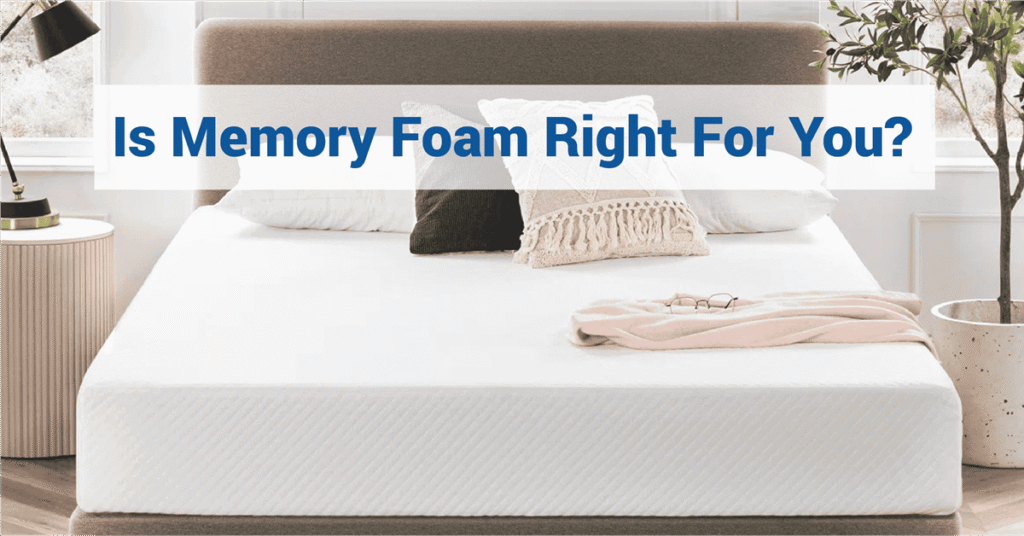
Is Memory Foam Right For You? Matching Material to Sleeper Type
When selecting a mattress that caters to your specific health needs, it’s important to consider your sleeping positions and other preferences. Here is how to choose the right memory foam mattress firmness and features for your needs:
By Sleep Position And Body Type
- Side Sleepers: It works best for side sleepers as foam relieves pressure effectively and aligns the spine. The ideal firmness is medium-soft to medium.
- Back Sleepers: To achieve a balanced contouring for your lower back, opt for medium-firm memory foam.
- Stomach Sleepers: For stomach sleepers, memory foam can make the hips sink too deeply. To prevent your back alignment, opt for a firm foam or a hybrid mattress.
- Heavy People (>230 lbs): The heavier sleepers may sink in memory foam, hitting the harder base layer. To prevent this, go for a high-density memory foam or hybrid models with coil support.
Pain, Injuries, And Mobility Considerations
If you suffer from arthritis, fibromyalgia, or chronic joint pain, the pressure-relieving qualities of memory foam work well. Some sleepers may benefit from mattresses engineered to reduce joint stiffness and inflammation. However, if you have mobility issues or weak core strength, the bounciness may make it hard to get in and out of bed. So, opt for a responsive hybrid mattress or latex instead.
Temperature, Climate, And Sweating
If you live in a hot climate or experience night sweats, traditional memory foam is known to retain heat. Choose a cooling memory foam mattress with copper or phase-change covers, or opt for a latex mattress.
Allergies, Chemicals, And Sustainability Preferences
Memory foam is synthetic, and if you want a natural bedroom setup, latex mattresses (made from rubber tree sap) are the better alternative. However, if you want safety, look for CertiPUR-US or GREENGUARD Gold certified foams.
You’re a good candidate for memory foam if:
- You wake up with joint pain or pressure points.
- You sleep on your side.
- Your partner’s movement wakes you up.
- You like the plush feeling of a memory foam bed.
How to Choose and Care for Memory Foam Mattresses, Pillows, and Toppers
From deciding on the right memory foam to creating a maintenance schedule, each step is important if you want a healthy sleeping surface. Let us discuss how to set up and care for a memory foam mattress:
Key Buying Criteria
- Density: Opt for at least 3.0 lbs/ft³ or 4-5 lbs/ft³ for longevity.
- Firmness: Side sleepers need Soft/Medium, while back/stomach sleepers need Medium-Firm/Firm.
- Accessories: Complete your memory foam bed with a memory foam pillow. It helps align your neck, so opt for thicker pillows as a side sleeper and thinner ones as a back/stomach sleeper. Use a memory foam mattress topper if you are unsure of buying a new bed. A pressure-relieving topper designed for joint pain can be a cost-effective way to improve comfort.
Trials, Warranties, And Price Expectations
- Trials: Look for brands that offer sleep trials of at least 100 nights. Your body requires 30 days to adjust to a new surface, and these trials help you decide if you have made the correct choice. Also, check if the brand offers a customer-friendly return policy.
- Warranty policies: Check if the brand provides a lifetime or a forever warranty. It must also cover sagging greater than 1 inch.
- Price: The memory foam mattresses are often budget-friendly, with prices starting from $100. Their costs increase depending on the engineered layers used or the additives. You can buy a topper first to test if it works for you.

Setup, Off-Gassing, And Break-In
- Unbox immediately: Do not leave it in the delivery box for more than a week or two.
- Ventilate: Put the mattress in an open room for 24-48 hours to allow off-gassing.
- Wait: It will take about 24-72 hours to expand for daily use.
Everyday Care And Lifespan Extension
- Use a protector: A waterproof mattress protector prevents sweat and spills that may damage foam.
- Rotate: Memory foam mattresses are one-sided, so rotate them head-to-toe every 3-6 months.
- Heat Safety: Be careful with electric blankets, as too much heat may damage the viscoelastic structure over time.
Memory Foam Shopping Checklist:
- Does the brand list the density? (opt for >3 lbs/ft³)
- Does it have gel-, or copper-infusion, or open-cell foam?
- Is it CertiPUR-US or GREENGUARD Gold certified?
- Is there at least a 100-night return policy?
- Do I have a compatible slatted or solid base?

Frequently Asked Questions
How long does a memory foam mattress last?
The durability of a memory foam mattress depends on its density, the frequency of use, and its maintenance. Most of the memory foam mattresses last for around 6 to 10 years. If you want longevity, look for high-density options (4-5 lb/ft³ or more) that resist sagging and body impressions.
Does memory foam always sleep hot, or can it stay cool?
Due to the dense construction of memory foam, they are known to trap body heat. However, many brands now use conductive materials like copper and graphite, along with gel-infusions to dissipate heat better. You can also look for designs that include open-cell construction, which promotes breathability.
Is a memory foam mattress good for back pain and joint pain?
Yes, memory foam mattresses work best for sleepers with back, hip, or shoulder pain. Its construction uses layers to distribute weight effectively and reduce pressure zones around joints. The slow responsiveness embraces the natural curves of the spine, improving alignment at night. While these are good options, the result varies by person, body weight, and the firmness level.
What is the difference between memory foam and regular foam mattresses?
On one hand, regular foam is made from polyurethane foam, while memory foam uses viscoelastic foam. The former is bouncy, and the latter material softens with heat and pressure, then returns to its shape after use. This slow-responsiveness gives memory foam mattresses better contouring and motion isolation. Standard foam feels more like a firm cushion with less pressure relief.
How is memory foam different from a latex mattress?
When comparing memory foam vs latex mattress, the main difference is their materials, as foam is synthetic while latex is natural. The memory foam contours your body and gives a slightly bouncy sensation, while latex gives more responsiveness and sleeps cooler due to its breathable material. Memory foam mattresses come under budget-friendly options, while latex mattresses come under the premium mattress category.
Is memory foam safe, or should I worry about chemicals and off-gassing?
Yes, if reputable brands make your memory foam mattress, it is safe to use. These models are often certified by CertiPUR-US, OEKO-TEX, or GREENGUARD Gold, which check the VOC emissions and harmful chemicals. If you are worried about off-gassing, leave the mattress in a well-ventilated room, and it will fade within a few hours.
How long does memory foam take to expand after unboxing?
Many memory foam mattresses are delivered as bed-in-a-box. These usually expand within a few hours of opening, but it is recommended to wait at least 24 to 72 hours. This time period helps it expand completely and reduces the off-gassing smell. Also, consider temperature, room ventilation, and foam density, so thicker and denser models may take more time to expand.
Conclusion
So, what is memory foam? In simple terms, it is an engineered viscoelastic polyurethane foam that targets pressure relief and motion isolation features in a sleeping surface. It has become an ideal choice for sleepers who want relief from joint pain and seek to sleep uninterrupted. But, it also comes with a few cons of heat retention, off-gassing, and giving a ‘stuck’ feeling.
Today, memory foam materials are designed to give you comfortable mattresses, pillows, and mattress toppers. To choose the right engineered construction, look at foam density for longevity, cooling technologies like gel or copper, and safety certifications like CertiPUR-US®. Compare a few high-rated memory foam and hybrid options to see if they work for your sleep position, body type, and climate.