




When you purchase through our links, we may earn a commission at no extra cost to you. As an Amazon Associate, DreamSlumber earns from qualifying purchases. Learn more.
To sleep with SI joint pain, make sure your pelvis is neutrally aligned by sleeping on your side or back. Further, use a pillow under your knees or between your knees and ankles to get the targeted support and keep the sacroiliac joint from twisting. To manage your joint pain, reset your pillows tonight and see if sleeping with the painful side up gives you the desired comfort. If you notice any additional symptoms like fever, sudden leg weakness, or if joint pain persists for more than two-four weeks, seek medical care.
Living with sacroiliac (SI) joint pain means you struggle every night when you roll over or try to adjust your sleep positions. The sharp and localized ache at the back of your pelvis leaves you feeling helpless at night, impacting your overall recovery. To manage your painful symptoms, it is important to learn how to sleep with SI joint pain and finally reclaim your rest. This discomfort occurs where your sacrum meets the ilium, a condition referred to as sacroiliitis.
This sacroiliac joint dysfunction may also occur while dealing with postpartum or due to sleeping with poor alignment of the pelvis. To find optimal relief, your joints must be stabilized by sleeping in the right position and a pillow between or under the knees. You can also reduce night flares and morning stiffness within just 7-14 nights by using the appropriate mattress support. However, if you suffer from chronic pain, consulting a physical therapist is the best option.
To find better relief over time, scroll down for a 7-step setup, a 10-minute pre-bed routine, and a 2 a.m. reset plan for when the pain disrupts your night.
Step 1: Is It SI Joint Pain or Something Else Keeping You Up?
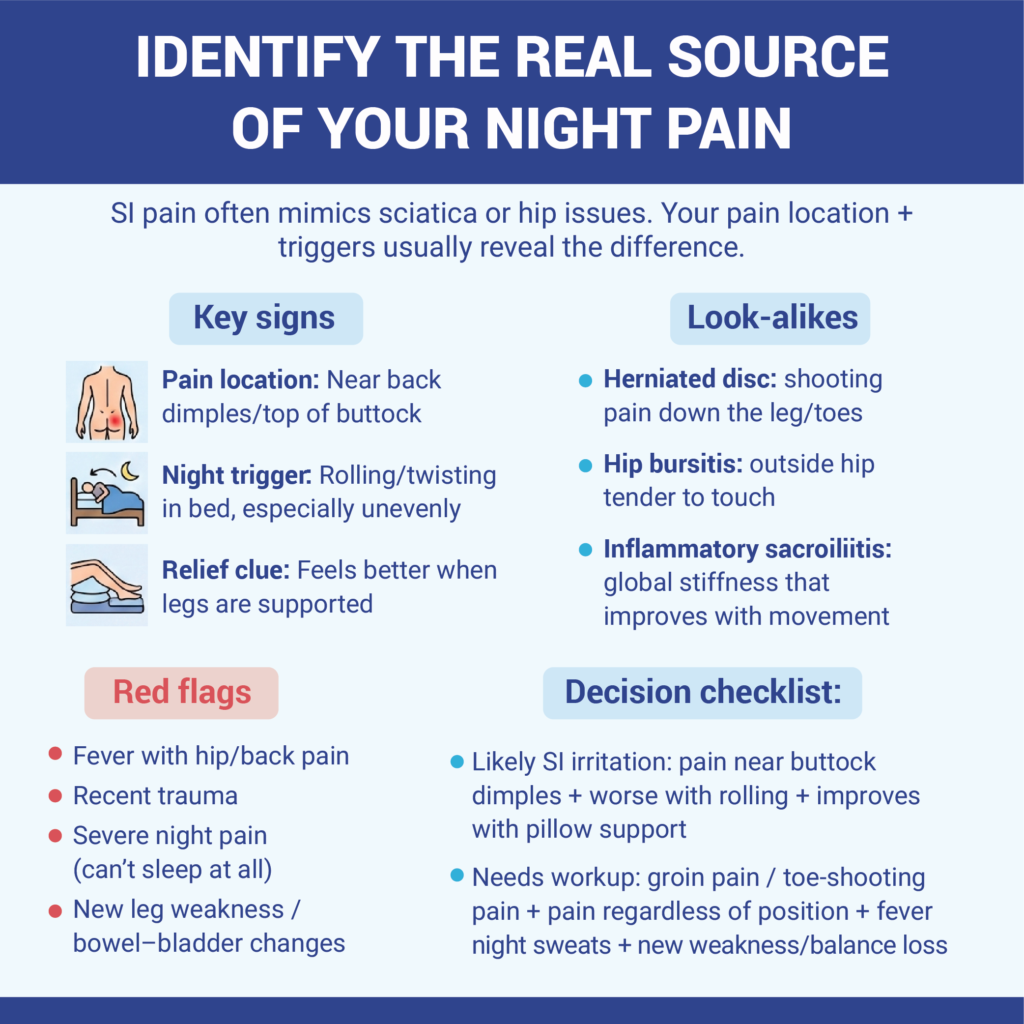
The common source of sacroiliac joint pain is the connection point between your sacrum and your ilium. The painful symptoms are similar to those of other conditions, like sciatica or hip bursitis. That is why it is important to understand your pain patterns to find the exact problem and fix it with the right strategy.
To identify if your low back pain at night is SI-related, look for these signs:
- Location of Pain: You will feel discomfort concentrated near the back dimples or the top of the buttocks. If it is a disc issue, pain will likely travel down to your toes.
- Pattern of Pain: You will notice flare-ups when turning in bed asymmetrically or standing up after a long time. This pain will lessen when your legs are supported.
- Potential Look-alikes: Your SI issues may seem similar to:
- A herniated disc, which causes shooting leg pain.
- Hip bursitis, which makes the outside of the hip tender to the touch.
- Inflammatory sacroiliitis, which often feels like global stiffness that improves with movement.
When to Stop and Get Checked
While most sacroiliac joint pain is mechanical, certain symptoms require an immediate medical evaluation. See a doctor if:
- Your hip pain when sleeping is accompanied by a fever.
- The joint pain follows a recent physical trauma.
- You experience severe night pain that keeps you from sleeping at all.
- You notice new neurologic symptoms, such as leg weakness or sudden changes in bowel or bladder control. These may be due to serious spinal cord issues.
Decision Tool: Is it SI Irritation?
Use this checklist to determine if your pain is mechanical SI irritation or if it needs a formal medical checkup:
| Symptom Check | Likely Mechanical SI Irritation | Needs Medical Workup |
| Pain Location | Near the back dimples/top of buttock | Deep in the groin or shooting to the toes |
| Nighttime Trigger | Rolling over or twisting in bed | Pain regardless of position or movement |
| Associated Signs | Improves with a pillow between the knees | Accompanied by fever or night sweats |
| Physical Activity | Worse after prolonged sitting/standing | Sudden loss of leg strength or balance |
Step 2: Best Sleeping Position For SI Joint Pain (Side Sleeping With Hips Stacked)
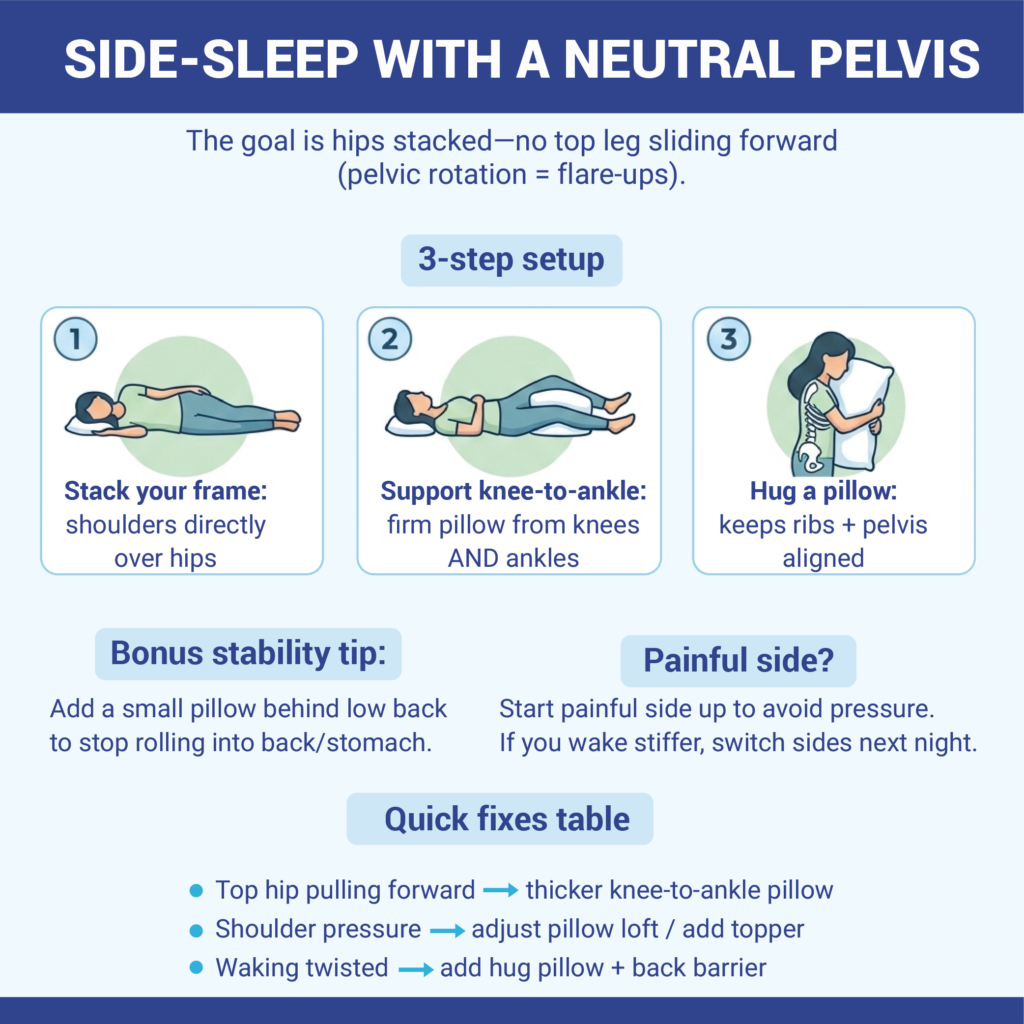
Most experts advise the side sleeping position, and you get the best comfort if you keep your hips perfectly stacked. However, you need to ensure that your top leg does not slide forward, which can cause pelvic rotation. This asymmetrical sleep position pulls on the sensitive ligaments of the sacrum. To prevent this, you require a setup that helps you maintain neutral pelvis alignment throughout the night.
Follow these steps to set up your bed for side-sleeping:
- Stack Your Frame: Sleep on your side and align your shoulders directly over your hips to make sure your torso is not twisted.
- Support the Legs: Place a firm pillow between the knees and ankles. Ensure that the pillow is extended down to your ankles. If you only support the knees, the lower leg can still twist the pelvis.
- Hug for Alignment: Sleep on your side and hug a body pillow or a firm pillow against your chest. This will neutrally align your ribs and pelvis, preventing you from rolling outwards into a face-down position.
- Create a Barrier: To avoid falling into the back or stomach sleeping position, place a small pillow behind your lower back.
Should I Sleep On the Painful Side With SI Joint Pain?
Most clinicians recommend starting with the painful side up to avoid direct pressure on the inflamed joint. However, every SI joint pain sufferer’s body is different. Check the next morning if you wake up feeling better or the same. This means your current position is working. However, if you wake up with increased stiffness, try switching sides the next night.
Side Sleeping Fixes
| Symptom | The Adjustment | Rationale |
| Hip pulling forward | Use a thicker pillow between the knees and ankles | Prevents the top hip from rotating inward and straining the SI joint. |
| Shoulder pressure | Adjust pillow loft or add a mattress topper | Relieves upper body stress so you don’t twist your lower body to compensate. |
| Waking twisted | Add a thick pillow and a back barrier pillow | Anchors the torso and pelvis to prevent unconscious rolling during the night. |
Step 3: How to Sleep On Your Back With SI Joint Pain (Pillow Under Knees)
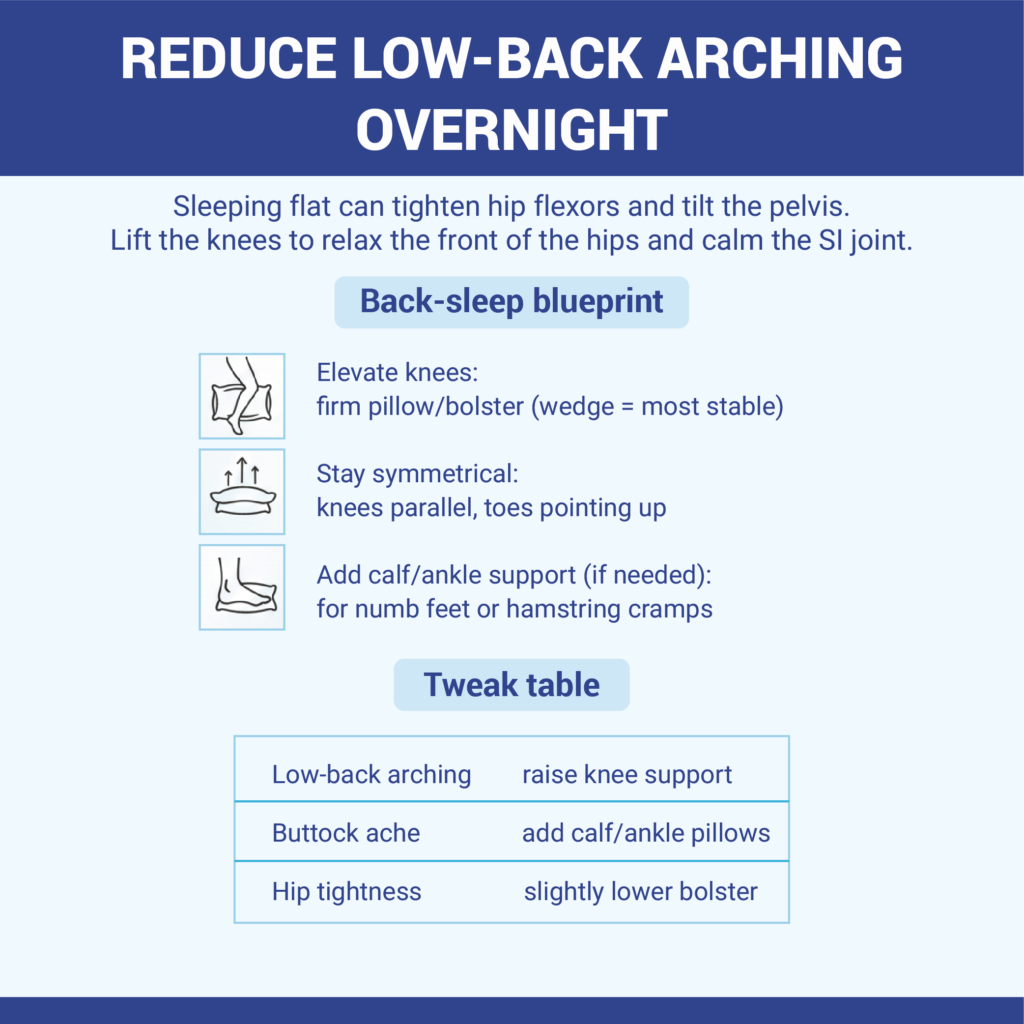
If your preferred sleeping position is sleeping on your back, focus on neutralizing your pelvis. When sleeping flat on the surface, your hip flexors tend to pull on the pelvis. This unnatural curve arches your lower back and puts stress on the sacrum. To prevent this, you must keep your knees lifted to relax these muscles and let the sacroiliac joint settle into a natural position.
To improve this setup, follow these steps:
Elevate the Knees
Position yourself flat on your back and take a firm pillow or bolster to place under both your knees. You can also consider using a wedge bolster to get uniform elevation. A standard bolster may shift under your weight or when you change positions at night.
Maintain Symmetry
Place your legs in a parallel position by letting one knee fall outward. This creates a twist in the sacroiliac joint. Your toes should point toward the ceiling so that your pelvis remains neutral.
Calf Support
While sleeping, if your hamstrings are cramping or your feet are numb, you must add support to your calves and ankles. You can add pillows under your ankles and knees. This setup will also prevent buttock pain flare-ups.
Back Sleeping Tweaks
Step 4: Sleeping Positions to Avoid with SI Joint Pain (and How To Roll Over Without Flaring It)
There is no one-size-fits-all solution to dealing with your SI joint pain, but you must find which position worsens your pain. Any position that forces your body into a scissor-like shape or causes your top knee to collapse forward will result in pelvic rotation. This torsion acts like a slow wrenching motion on your sacroiliac joint. Further, these factors make back pain at night even more inevitable.
To protect your SI joints, avoid doing the following and use these replacements instead:
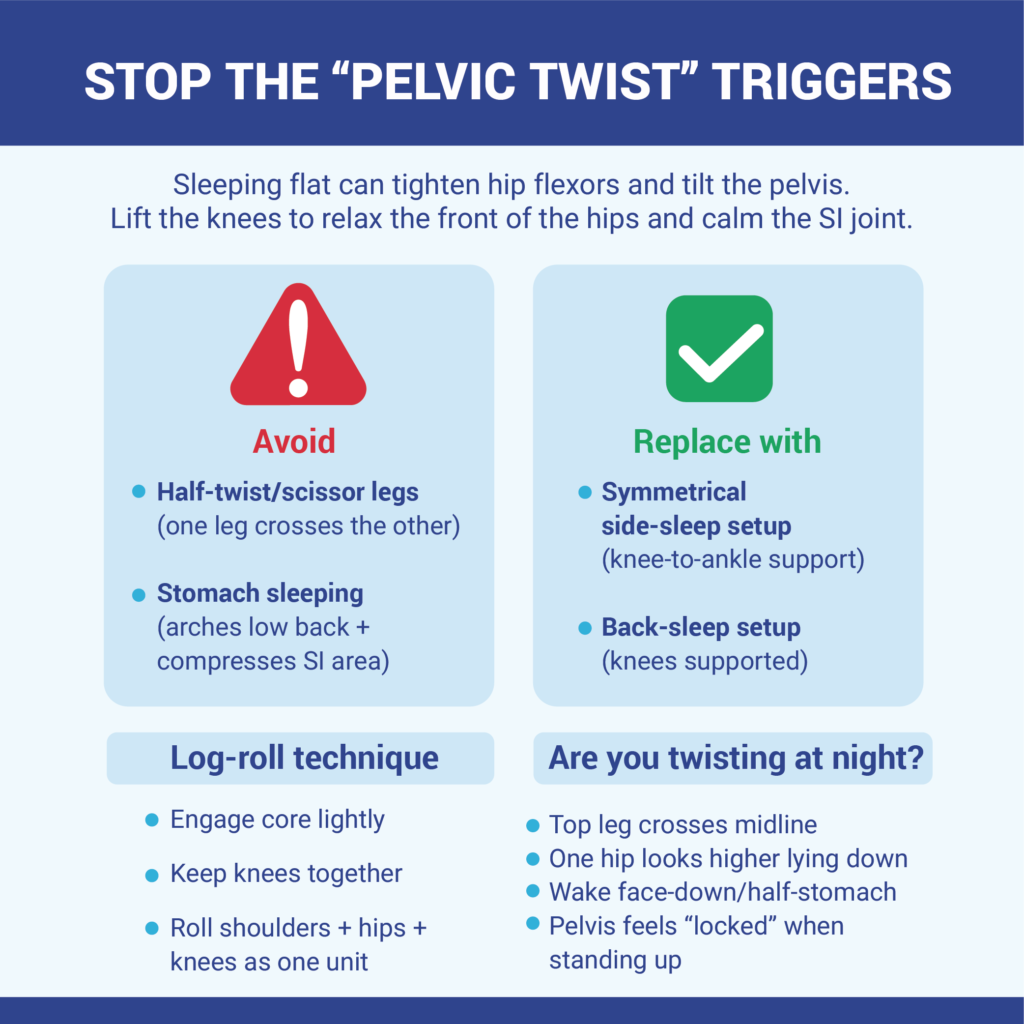
- Avoid the Half-twist: Try to avoid sleeping with one leg on top of the other straight leg (the scissor leg). This creates excessive torsion on the sacrum.
- Avoid Stomach Sleeping: When sleeping face-down, your lower back arches unnaturally, forcing your spine into poor alignment. It also pinches the sacroiliac joint, leading to morning stiffness.
- Replace with Symmetry: To get into a symmetrical position, use a side setup that keeps your knees and ankles supported. You can also use the back setup with supported knees distribute your weight evenly.
The “Log-Roll” Technique
If SI joint pain disrupts your sleep in the middle of the night when you try to turn over, this may be due to your spine getting twisted before your hips. Most clinicians recommend the “Log-Roll” to move as one solid unit. To do this, engage your core, keep your knees together, and roll your shoulders, hips, and knees at the same time. This reduces pelvic rotation and prevents the sharp and stabbing pain felt during bed mobility.
Are You Accidentally Twisting At Night?
- Your top leg crosses the midline of your body.
- One hip is visibly higher than the other when you lie down.
- You wake up face-down or halfway on your stomach.
- Your pelvis feels rotated or locked when you first stand up.
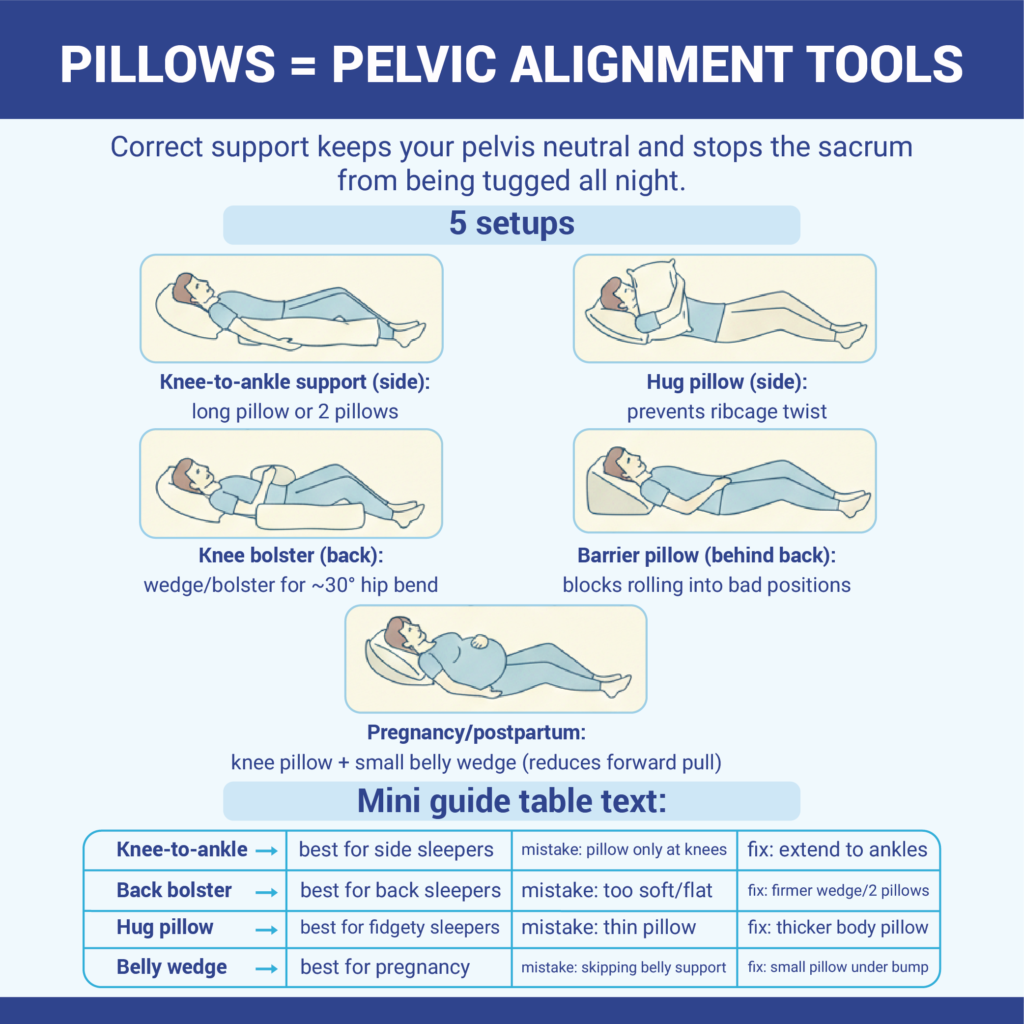
Step 5: Where to Put Pillows for SI Joint Pain (5 Proven Setups, Including Pregnancy/Postpartum)
To create the most comfortable setup for your SI pain, you need the right pillow placement. This will help you get the ideal alignment for your pelvis through the night. Moreover, using a pillow support prevents your weight from shifting and pulling on the sensitive ligaments of the sacrum.
Follow these five setups to keep your body in place and minimize hip pain:
Side-Sleep Knee-To-Ankle Support
Use a single long body pillow or two firm standard pillows to support the top leg from the knee to the ankle. With this setup, make sure your top hip is stacked directly on top of the bottom hip. This further prevents the internal pelvic rotation that causes buttock pain. To get the best comfort, you can also invest in a supportive mattress for anterior pelvic tilt.
Side-Sleeping with Pillow Hugging
You can use a large and firm pillow against your chest to keep your shoulders and ribcage from twisting forward. This locks your upper body in place so that your spine does not arch unnaturally. This would otherwise transmit torque down to the SI joint.
Back-Sleeping with Knee Bolster
Invest in a thick bolster or a wedge pillow so that you can place it under both knees. This helps create about 30 degrees of hip flexion. The back sleeping position, along with knee support, relaxes the psoas and hip flexor muscles. Not following this setup may tighten your hip flexors and pull on the ilium when your legs are flat.
Barrier Pillow
If you are prone to rolling into an asymmetrical position at night or onto your stomach, place a firm pillow behind your back. This will keep your body in place and keep it in a side-sleeping position through the night. However, if you must sleep on your stomach, make sure you get the right mattress for sleeping face-down and keep your spine supported.
Pregnancy/postpartum Setup
During pregnancy, the hormone relaxin softens your ligaments. This makes the SI joints excessively unstable. To overcome this, use a pillow between your knees and a small wedge under your belly. This will prevent the baby’s weight from pulling your pelvis into a forward tilt.
Setup Guide for SI Comfort
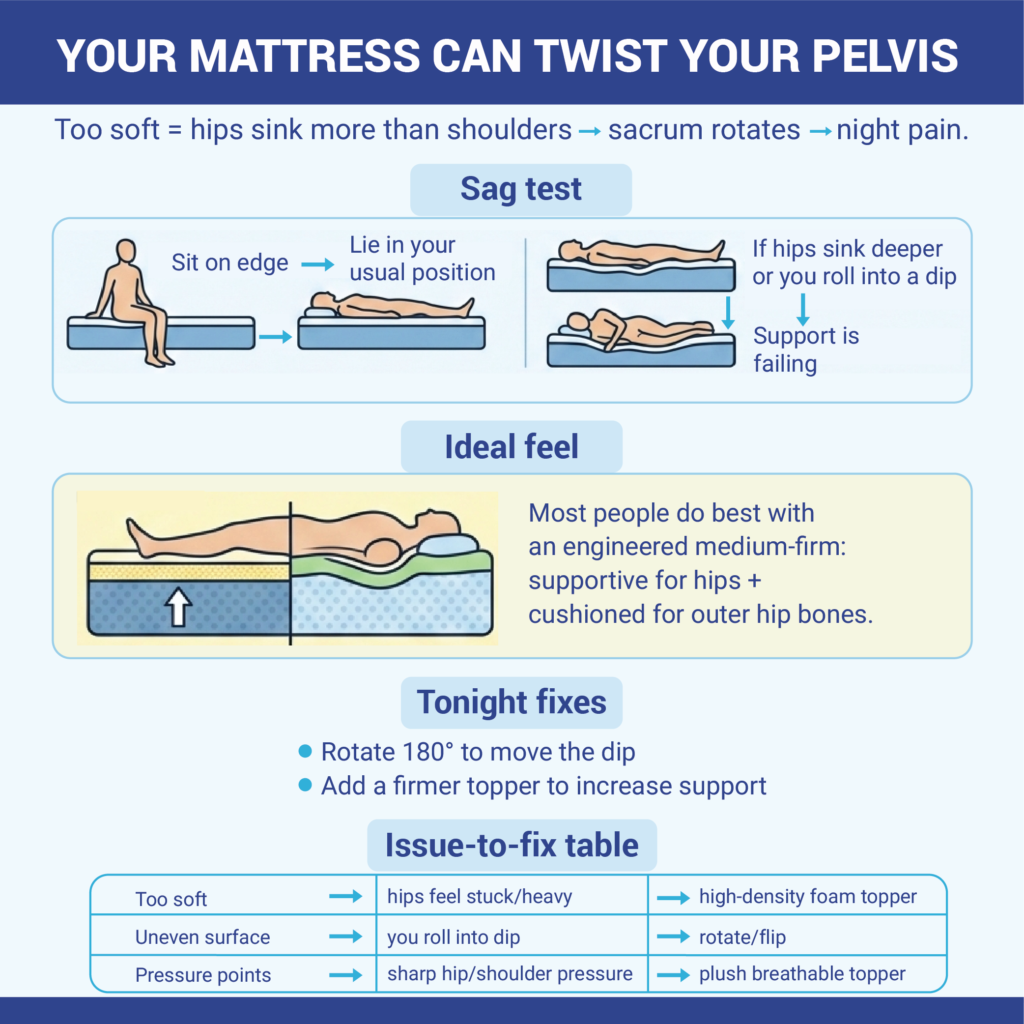
Step 6: Best Mattress Firmness for SI Joint Pain (and How to Fix a Sagging Bed Tonight)
Your mattress forms the foundation of your bed setup to help you target deep sleep at night. An unsupportive surface often leads to lower back pain at night. If a mattress is too soft, your heavy pelvic region sinks faster than your ribcage. This mattress sag forces the sacrum into a twisted position. Hence, your goal must be to find a surface that is responsive enough to keep your hips level while cushioning the bony prominence of your ilium. Let us discuss how you can achieve this:
The Sag Test
Sit on the edge of your bed and then lie in your usual position. See if your hips sink deeper than your shoulders, or if you naturally roll into the center. If your answer is affirmative, your mattress has lost its structural integrity.
The Ideal Firmness
People with sacroiliac joint pain are often recommended to use an engineered medium-firm mattress. This is because this firm yet supportive feel becomes more comfortable for the pelvic zone. It offers the best alignment to prevent pelvic rotation while giving pressure relief on the outer hip.
Quick Nightly Fixes
If you are looking for instant relief tonight with your current mattress, rotate it 180 degrees. This will move the dip away from your hips. You can also temporarily use a firmer mattress topper to see if the increased support reduces your sacroiliitis pain.
Mattress Issues and Fixes
| Mattress Issue | What You Feel | The Fix |
| Excessive Softness | Hips feel stuck or heavy | Add a high-density foam topper. |
| Uneven Surface | You keep rolling into a dip | Rotate or flip the mattress. |
| High Surface Tension | Sharp pressure on the hip/shoulders | Add a plush and breathable topper. |
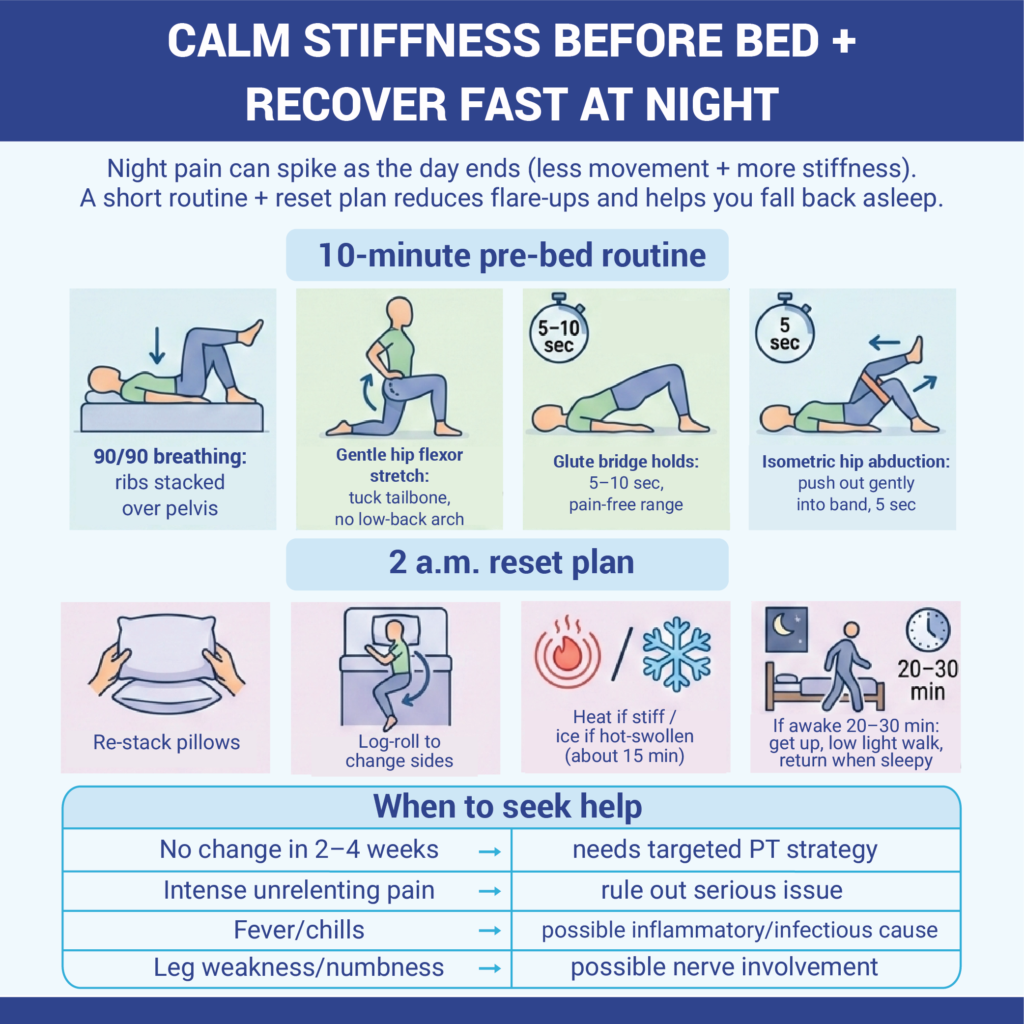
Step 7: SI Joint Pain Worse at Night: 10-minute Pre-Bed Routine + a 2 a.m. Reset Plan
For many, sacroiliac joint pain feels more intense at night. This is because by the end of the day, your body’s natural anti-inflammatory cortisol levels drop. Moreover, the lack of movement leads to joint stiffness. To overcome this, you must create a nighttime routine before bed and a plan for when your sleep gets interrupted.
10-Minute Pre-Bed Routine
You can follow this short mobility routine to downshift your nervous system and relax the muscles surrounding the sacrum and ilium:
- 90/90 Breathing: Get on your back with your feet flat on a wall, and make your hips and knees at 90°. Take slow and deep diaphragmatic breaths to stack your ribs over your pelvis and reduce muscle tension.
- Gentle Hip Flexor Stretch: Kneel on one knee and use a cushion underneath, and tuck your tailbone under without arching your lower back.
- Glute Bridge Holds: Sleep flat on your bed with knees bent and lift your hips into a pain-free range. Hold for 5-10 seconds to activate the glutes to stabilize the sacroiliac joint.
- Isometric Hip Abduction: Get on your back and keep your knees bent. Bind a resistance band around your thighs. Then, gently push outward for 5 seconds to engage the glute medius.
The 2 a.m. Reset Plan
Follow these steps on what to do when SI joint pain wakes you up at night:
- Re-stack Your Pillows: If your pillow support has shifted or flattened under your weight, reposition it.
- Log-roll to Change Sides: If you need to turn over to another position, use the ‘log-roll’ method to move your shoulders and hips simultaneously.
- Apply Heat or Ice: Use ice for 15 minutes if the joint feels hot or swollen. Alternatively, use a heating pad if the area feels stiff and tight.
- The 20-Minute Rule: If you face difficulty falling back to sleep after 20-30 minutes, get out of bed. Walk in low light and return to bed when you feel sleepy again.
When to Seek Professional Help
If your hip pain persists despite these adjustments, it may be time for a more clinical approach.
| See a PT or Doctor if… | Rationale |
| No change in 2-4 weeks | Suggests a mechanical issue that needs targeted physical therapy for SI joint pain. |
| Intense, unrelenting pain | Could indicate a more severe problem, like a fracture or joint infection. |
| Fever or chills | These are symptoms of inflammatory sacroiliitis or infection. |
| Leg weakness/numbness | May indicate nerve involvement that requires urgent evaluation. |

Frequently Asked Questions
What is the best sleeping position for SI joint pain?
The ideal sleeping position to get relief from SI joint pain makes sure your sacrum and ilium are in a neutral alignment. For most people, the side sleeping position works best when combined with a firm pillow between the knees and ankles. If you still do not find comfort, you can try sleeping on your back with a large pillow under your knees.
Should I sleep on the painful side or keep it on top with SI joint pain?
It is important to know how to sleep with SI joint pain on your side, as sleeping on the painful side may aggravate your inflammatory symptoms. Experts suggest sleeping with the painful side facing up. This prevents direct compression of the inflamed joint and surrounding tissues. However, if this position makes your top hip fall forward, use a body pillow to stay supported.
Where to put a pillow for SI joint pain while sleeping?
If you are a side sleeper, place a pillow between knees and ankles for SI joint pain to keep your hips neutral and stacked. You must make sure that the bolster pillow is thick enough to bend your hips slightly. This helps flatten your lower back and reduces tension on the SI joint.
What sleeping positions make SI joint pain worse?
As an SI joint pain sufferer, you must avoid sleeping on your stomach or in a scissor-like position (one leg over another). When you sleep with your face down, your spine is forced into an excessive arch. The scissor legs create a pelvic rotation that strains the ligaments of the sacrum. Both of these habits can lead to buttock pain and stiffness in the morning.
Why is SI joint pain worse at night?
SI joint pain becomes worse at night due to a lack of movement and cortisol production. When you walk during the day, your joints remain lubricated. However, staying in one position for hours at night causes inflammation around the sacroiliac joint. Additionally, a sagging mattress may also cause hip pain when sleeping on it for several hours.
How long does it take for SI joint pain to improve with sleep changes?
Most people see improvement in their sacroiliitis symptoms within 1 to 2 weeks of consistent changes. It takes time for the inflamed ligaments to settle. Hence, you diligently use a pillow between your knees every single night. If you are also dealing with postpartum SI joint pain, relief may take longer due to ongoing hormonal changes affecting your sleep quality.
When should I see a doctor or physical therapist for SI joint pain?
Despite making position changes, following a bedtime routine, and creating a supportive sleep surface, if your pain does not improve after 2 to 4 weeks, seek medical help. You must also consult a physical therapist if your groin pain referral becomes severe. Further, seek professional evaluation if your pain is accompanied by symptoms like fever, weight loss, or leg weakness.
Conclusion
In your quest to understand how to sleep with SI joint pain, it is important to observe your pain patterns and understand its actual source. Create a supportive sleep surface by using bolster and wedge pillows, and sleep on your good side for relief. If you have to sleep on your back, place a firm pillow under your knees. To minimize sleep disruptions at night, follow a 10-minute pre-bed mobility routine with a 2 a.m. reset plan.
These consistent efforts to neutrally align your pelvis and stabilize the sacroiliac joint help you protect your ligaments. To get relief tonight, you can also apply heat/ice therapy. For long-term comfort, invest in a proper mattress with a medium firm feel today. If your symptoms persist, consult a physical therapist to get tailored treatment.