




When you purchase through our links, we may earn a commission at no extra cost to you. As an Amazon Associate, DreamSlumber earns from qualifying purchases. Learn more.
You have just set up a camping bed or a sleeping space for guests with your air mattress, but then you notice it has deflated within minutes because of a puncture or leak. In such situations, knowing how to patch an air mattress saves you from frustration. You can do this in three easy steps, where you have to first locate the leakage area and the severity of damage. Then, choose the right patching method, using a vinyl repair kit or a DIY fix with duct tape, and test if it works.
Here, you will learn everything about using a PVC patch kit with adhesive and household alternatives. The guide will show you how to fix seam leaks and valves, and how to prevent leakages. Scroll down for detailed step-by-step instructions, safety tips, and expert advice to repair your air mattress.
Understand Why Air Mattresses Leak and When They Can Be Repaired
When looking to patch or replace your air mattress, you must first check the source of the leakage and the reason behind it. Most of the air leakage is fixable, but some may need replacement. Let us discuss how you can determine when to repair or when to replace:
Common Causes of Air Mattress Leaks
Most of the air mattresses are made either from vinyl or Polyvinyl Chloride (PVC). These may get worn out over the years of use and can cause air leakage for various reasons. The common causes for an inflatable bed leak are:
- Punctures from Sharp Objects: Pet claws, jewelry, keys, or debris on the floor can create small holes.
- Rough Surfaces: If you keep the mattress directly on the ground, abrasions and punctures may cause leakage.
- Overinflation: Overfilling the air in the mattress may put more stress on the seams, stretching or splitting them.
- Normal Wear And Tear: The material can become brittle and crack over time, especially if it’s frequently inflated and deflated.
- Valve Leaks: If the valve is not sealed tightly or if the seal is damaged, leakage will happen.
Types of Damage: Pinholes vs Tears vs Seam Failures
After understanding the cause of damage, the next step is to check the kind of damage on the mattress. These can include:
- Pinholes: These are tiny punctures that are easy to patch.
- Tears: These are larger than pinholes and more serious but are repairable.
- Seam failures: Seam failure occurs due to overinflation or material fatigue. It is a bit difficult to repair them.
- Valve problems: Air can escape if the valve of the air mattress is not closed properly or its seal is damaged.
When to Repair and When to Replace
Based on the cause and the type of damage, you can decide if you can fix it or if you need to replace it with a new one. You can take help from this short checklist:
Repair it if:
- The damage is a small pinhole or tear on a flat surface.
- The mattress is new and in good condition otherwise.
- The leak is at the valve, which can be sealed.
Replace it if:
- The tear is larger than a few inches.
- The leak is on a seam, and the material is stretched.
- The mattress has multiple leaks.
- The mattress is old, and the material has become brittle.
- You cannot afford a vinyl repair kit, do not have the time to repair it, and would rather buy a new one.
Gather the Right Tools and Materials to Patch an Air Mattress
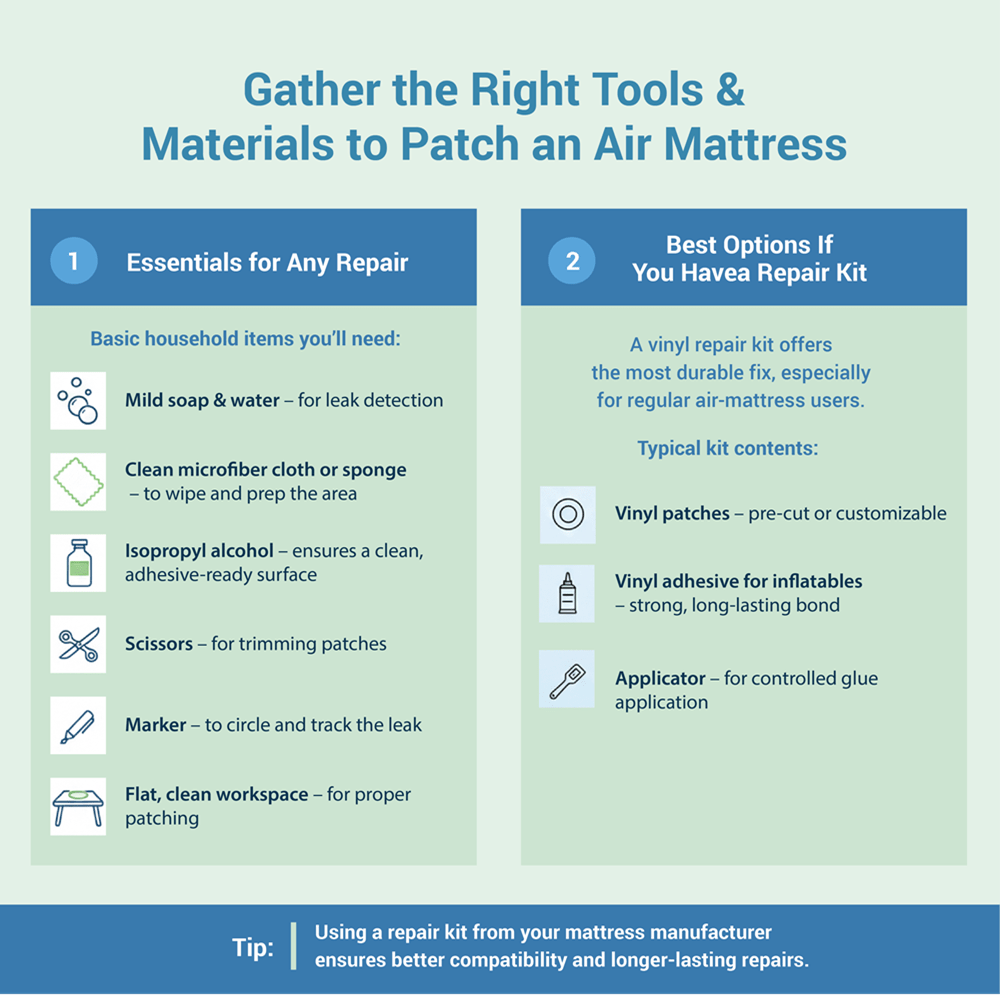
Now that you have decided to repair your air mattress, it is time to understand which tools will work best. You can either use an air mattress repair kit or use daily household items, depending on whether you want a temporary or permanent fix. These include:
Essentials for Any Repair
The basic household items and essentials you will need are:
- Mild soap and water
- A clean microfiber cloth or sponge
- Isopropyl alcohol for cleaning the area
- Scissors
- A marker to circle the leak
- A flat and clean workspace
Best Options If You Have a Repair Kit
If you use your air mattress regularly and want to know how to fix a slow leak in an air mattress, buying a vinyl repair kit is your best option. It includes all the essentials for patching and sealing a PVC airbed, such as:
- Vinyl patches
- Vinyl adhesive for inflatables
- An applicator
You may get a repair kit from your air mattress manufacturer, which is compatible with their products. These may fix most of the damage to make the mattress last for years.
Safe Household Alternatives When You Don’t Have a Kit
To fix your air mattress temporarily, you do not need a high-end repair kit. In fact, you can use household items that are easy to use and affordable. The tale below compares them based on the materials they are compatible with, durability of repair, and benefits:
| Material | Works on | Temporary or long-term | Pros | Cons |
| Duct tape | Vinyl, PVC | Temporary | Readily available, easy to apply | Not waterproof, adhesive can weaken over time |
| Gorilla tape | Vinyl, PVC | Semi-permanent | Stronger and durable than duct tape | Can leave a sticky residue |
| Flex Tape | Vinyl, PVC | Semi-permanent | Waterproof and creates a strong bond | It can be difficult to apply smoothly |
| Bicycle tube patch | Rubber | Semi-permanent | Designed to patch inflatable items | May not adhere well to vinyl or PVC without the right adhesive |
| Super glue | Small pinholes | Temporary | Dries quickly and creates a hard seal | Can be brittle and crack over time |
| Clear nail polish | Small pinholes | Temporary | Seals small leaks quickly | Not very durable and may peel off |
How to Find a Leak in an Air Mattress (Before You Patch)
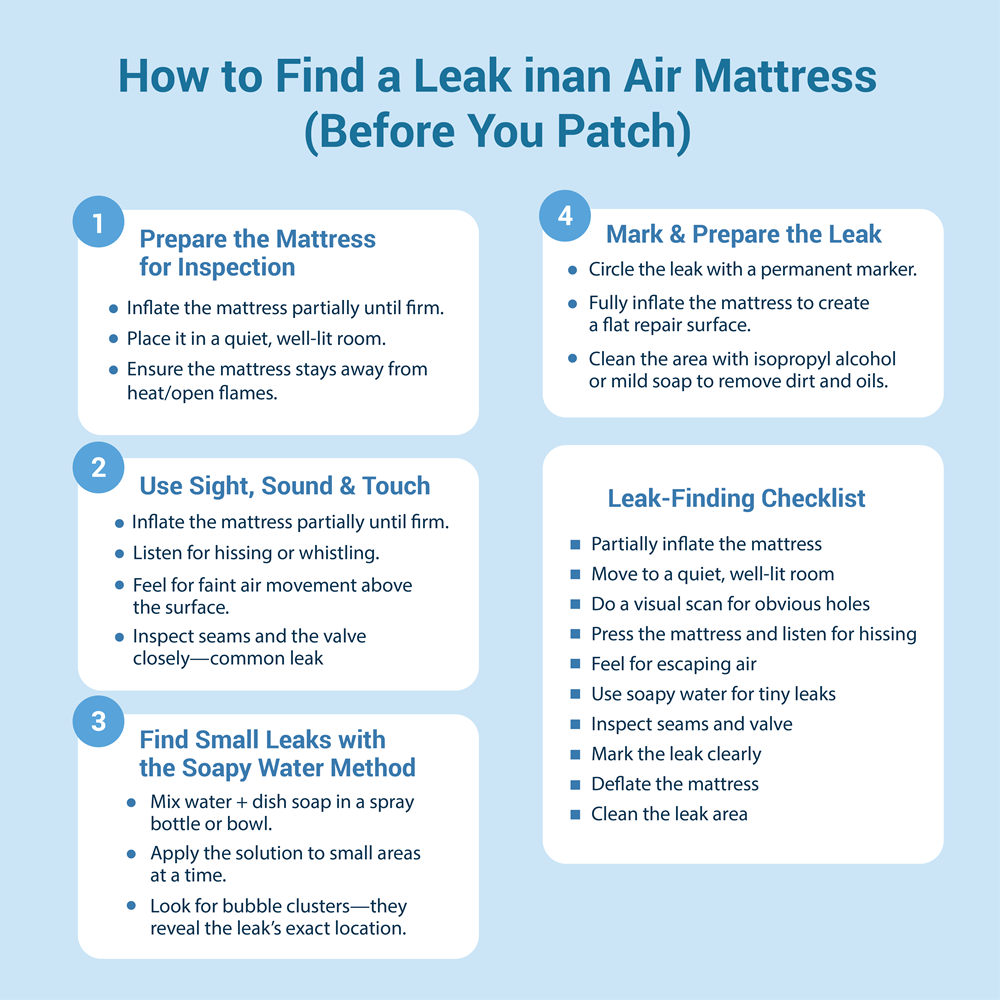
Wondering how to find a hole in an air mattress? Before you gather your tools, look for the tiny punctures that are difficult to locate. Follow these steps to get started:
Prepare the Mattress for Inspection
The first step is visual inspection. For this, inflate the mattress partially such that it is firm but not overfilled. This step will create pressure for the air to escape, making it easy to locate. Make sure you place the mattress in a well-lit and quiet room, where you can get a clear view of the entire surface. To ensure safety, keep the vinyl mattress away from open flames or high heat sources during inspection and repair.
Use Sight, Sound, and Touch to Locate Obvious Leaks
Next, press the mattress slowly downwards on different areas of the mattress. Listen carefully for any hissing or whistling sounds. Keep running your hands slightly above the surface to feel the air escaping. This will help you locate larger holes or tears. Pay extra attention near the seams and valve, as these are commonly damaged parts.
Use The Soapy Water Method For Hard-To-Find Leaks
If the puncture is tiny, the air will leak very slowly, which can be hard to see or hear. For this, follow these steps on how to find a leak in an air mattress with soapy water:
- Mix a small amount of dish soap with water in a spray bottle or a bowl.
- Spray or wipe the soapy solution onto the surface of the mattress, working in small sections.
- Watch closely for bubbles to form. As the air escapes, a cluster of bubbles will form at the source of the leak.
- Mark and Prepare the Leak Area
After locating the problem area in your mattress, mark the spot by circling it with a permanent marker. Once done, inflate the mattress completely to prevent air from interfering with the adhesive. This also gives a flat surface for patching up the mattress. Further, use isopropyl alcohol or mild dish soap to clean the damaged area to remove any oil or dirt residue.
Leak-Finding Checklist:
- Inflate the mattress partially.
- Move to a quiet and well-lit area.
- Inspect visually for obvious holes.
- Listen for hissing sounds while pressing on the mattress.
- Feel for escaping air with your hands.
- Use the soapy water method for tiny leaks.
- Check the seams and valve carefully.
- Circle the leak with a marker.
- Deflate the mattress completely.
- Clean the area around the leak.
Step-by-step: How to Patch an Air Mattress With a Repair Kit
A vinyl repair kit, which often comes with your air mattress, helps you repair it with a permanent air mattress patch. The entire process for fixing is easy, and you just need to follow these steps for a strong and flexible sleeping surface:
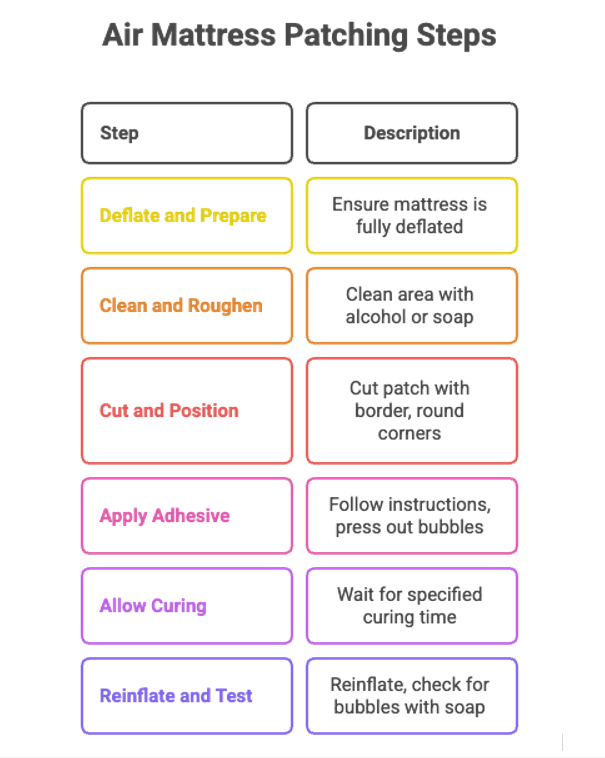
Deflating and Preparing the Mattress
Completely deflate the mattress to create a flat and stable surface to patch it up without trapping the air. This step is important as trapped air may push the patch off from inside. It will also help the adhesive stick the patch strongly on the surface.
Clean and Lightly Roughen the Surface
To clean the surface, you can use isopropyl alcohol or a mild soap solution. If the mattress has a smooth and glossy finish, lightly roughen the area with a small piece of sandpaper. This helps the adhesive stick to the surface and bond securely.
Cut and Position the Patch
Some of the repair kits come with a sheet of patching material. Cut up a piece from it large enough to cover the hole, about 1-2 cm border on all sides. Make sure it is round in shape to keep it from peeling with time. Position it such that it doesn’t overlap any seams or creases.
Apply Adhesive and Press Out Air Bubbles
Follow the instructions on the repair kit to understand how to properly use adhesive on the mattress. This will help you determine if your adhesive requires a contact method (applying glue to the patch and mattress) or if it needs to be applied wet. Place the patch over the hole and press down firmly, starting from the center and working your way out. Use a spoon, a roller, or your fingers to smooth out any air bubbles.
Allow Full Curing Time
After applying the adhesive, allow it to cure for a few hours. It may take up to 24 hours. Do not skip this step if you want your air mattress repair to last longer. You can place a flat weight, like a heavy book, on top of the patch to maintain pressure while it cures.
Reinflate and Test the Repair
After the adhesive has cured completely, inflate the mattress and apply the soapy solution over the patch to check for air bubbles. If the patch stays put, keep the mattress inflated overnight to see if it shows signs of air leakage the next morning. If it stays firm, you have repaired it successfully.
How to Patch an Air Mattress Without a Patch Kit
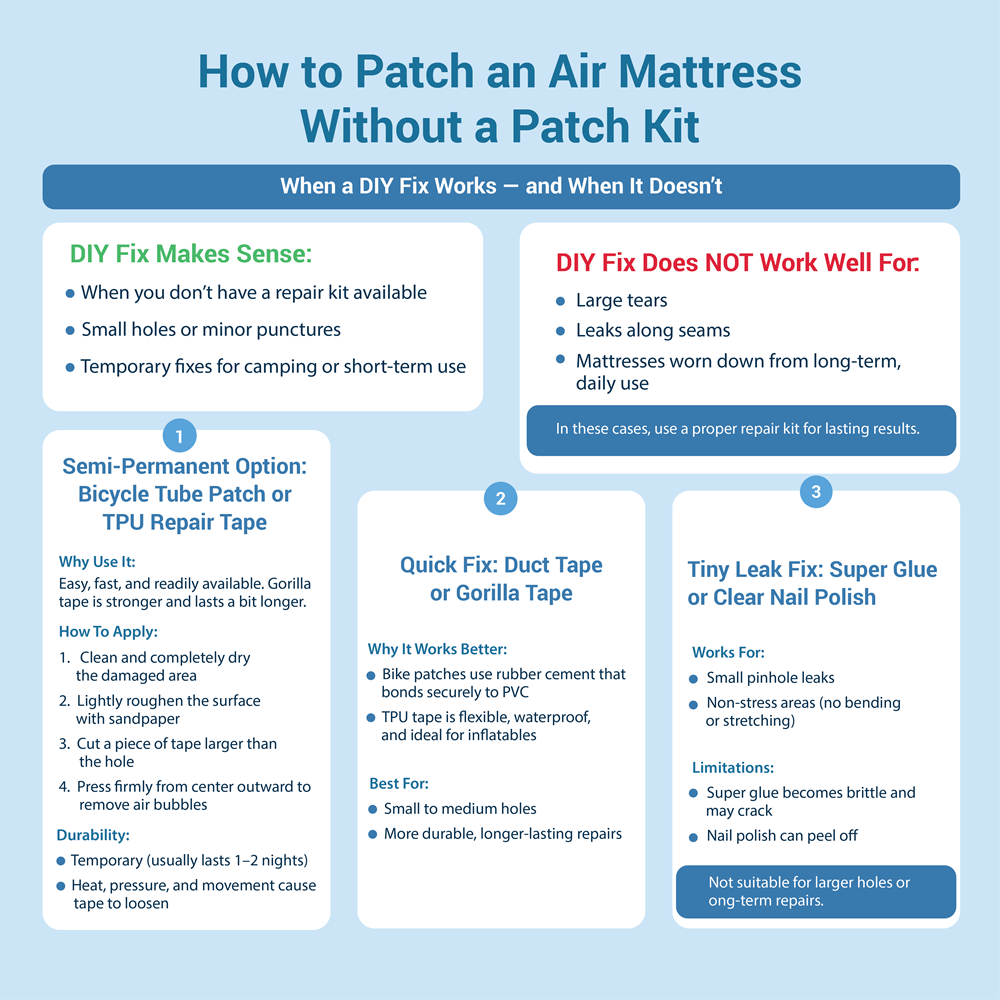
Even if you do not have a patch kit, you can still use household items for a temporary mattress fix. Some of these methods can be very durable if done properly. Let us discuss these methods in detail, along with their pros and cons:
When a DIY Fix Makes Sense (and when it doesn’t)
You can make a do-it-yourself (DIY) patch when you don’t have a repair kit handy for a camping air mattress repair. However, for large tears, leaks in the seam, or abrasion due to long-term daily use, a professional repair kit is better. A temporary fix may not be enough to withstand constant pressure and flexing, leading to a slow leak.
Quick Duct Tape or Gorilla Tape Patch
Duct tape is the most handy household tool to repair most items. It can also work temporarily on your air mattress. If you are wondering, can you use Gorilla tape to repair an air mattress? The answer is yes, and it works even better due to its stronger adhesive and thicker construction. Here are the steps on how to fix a hole in an air mattress with duct tape:
- First, clean and thoroughly dry the area around the hole.
- For best results, you can roughen the surface gently with sandpaper to help the adhesive stick.
- Cut a piece of tape, larger than the hole, and apply it smoothly.
- Press firmly from the center outwards to remove any air bubbles.
Note: This method is temporary and can last for a night or two. The heat and movement overnight may result in the tape losing its grip.
Using a Bicycle Tube Patch for an Air Mattress or Repair Tape as a Semi-Permanent Option
You can also use a bike tube patch or a roll of TPU (thermoplastic polyurethane) repair tape as a more durable fix. A bike patch kit comes with rubber cement, creating a secure seal on a PVC airbed patch. Similarly, TPU tape is a flexible and waterproof tape, effective for repairing inflatables, and can provide a semi-permanent solution.
Super Glue And Nail Polish
If your mattress has a pinhole damage and you are wondering how to fix a slow leak in an air mattress, you have super glue and nail polish for your rescue. These work for tiny and non-stress-point punctures. However, they are not a reliable solution for larger holes or tears. Super glue can become brittle and crack, and nail polish can peel off easily.
DIY Methods vs Best Use-case Table
| Method | Best for | Lifespan | Risk level | Notes |
| Duct Tape | Small punctures, emergencies | Temporary (1-3 nights) | High | Can peel easily, not waterproof |
| Gorilla Tape | Small to medium punctures | Temporary to Semi-Permanent | Medium | Stronger than duct tape, but it can leave residue |
| Flex Tape | Small to medium punctures | Semi-Permanent | Medium | Waterproof and strong, but can be hard to apply flat |
| Bicycle Tube Patch | Small punctures | Semi-Permanent | Low | Good adhesion with rubber cement, but it may not work for all mattress materials |
| Super Glue/Nail Polish | Tiny pinholes only | Very Temporary | High | Brittle and can crack easily, not for high-stress areas |
Fixing Special Problem Areas: Seams, Flocked Tops, And Valves
The process of patching up a puncture is comparatively easier than fixing leaks in seams, flocked tops, and valves. These require specific steps and special attention, as discussed below:
How to Repair An Air Mattress Seam Leak
The best way to patch an air mattress seam leak is by using a flexible adhesive and a strong patch for which you can follow these steps:
- Clean the seam thoroughly.
- Apply a flexible adhesive directly into the split of the seam.
- Put a patch that overlaps the seam on both sides. Clamp the patch down flat while it cures to make sure it bonds well with the surface.
- You can use two flat objects, like blocks of wood, and clamps to apply even pressure.
If the seam is split completely, consider replacing the mattress instead of fixing it.
How to Patch A Flocked Air Mattress Surface or Textured Sleeping Surfaces
Many air mattresses come with a fuzzy surface to give you extra comfort. However, these flocked mattresses do not bond well with adhesives. To patch a hole on a flocked top:
- Create a smooth surface by gently shaving or sanding the flocking material around the hole. Do this until the vinyl or PVC surface beneath it is exposed.
- Continue with the standard patching steps after you uncover the smooth surface.
- Do not sand too harshly, as you could damage the mattress material.
How to Repair An Air Mattress Valve Leak At Home
Once you have inspected the entire surface of the air mattress and still can not find the leak, it is time to check the valve. You can fix a mattress valve leak without a patch by:
- Use the soapy water leak test around the valve to confirm the source of air leakage.
- Check for any dirt, sand, or debris that might have made the seal or plug ineffective.
- Clean the valve and the plug again securely. If the leak persists, check the valve gasket or O-ring for any signs of damage or cracking.
- If the gasket is damaged, you may contact the manufacturer for its replacement.
In some cases, a leaky one-way valve may not be repairable. You may need to replace the entire mattress.
Test Your Repair, Stay Safe, and Avoid Repeat Leaks
Once you have followed all the steps for fixing your air mattress, test if it holds the air and withstands the pressure. Let us discuss the steps for running a post-repair leak test and important safety tips for lasting comfort:
Run a Proper Leak Test After Patching
To see if your patch has successfully sealed the puncture, follow these steps:
- Partially inflate the mattress and spray the patched area with soapy water. Look for any new bubbles.
- If the patch passes the bubble test, inflate the mattress completely. Place yourself on it for at least 20-30 minutes to apply pressure and focus on the patched area.
- Finally, leave it completely inflated for at least 8-12 hours. If it remains firm, your repair was a success.
Note: Minor deflation can be caused by temperature changes, as cooler air is denser. However, if it shows too much loss of air, it may be due to a remaining leak.
Safety Tips When Sleeping On A Patched Air Mattress
Once your mattress is repaired, follow these safety tips:
- Avoid placing the patched area directly on sharp or uneven surfaces.
- When indoors, keep the mattress away from heaters or open flames, as the vinyl material can be flammable. For general guidance on avoiding household fire hazards, you can refer to this consumer fire-safety guide.
- Follow the maximum weight capacity to avoid putting undue stress on the seams and the patch.
Simple Habits To Prevent Future Damage
Always try to prevent leaks rather than to repair them. Therefore, to extend the life of your air mattress, consider these tips:
- Use a ground cloth or tarp when on a campground surface to protect it from rocks and twigs.
- At home, a protective mattress topper can protect it from pet claws and sharp objects.
- Avoid jumping on the mattress and be careful not to overinflate it.
- When you’re done using it, make sure it is clean and dry before storing it loosely folded.
Before you sleep on a newly patched mattress, check:
- Did you test the patch with soapy water?
- Did you apply pressure to the patch for several minutes?
- Did the mattress stay fully inflated overnight?
- Is the sleeping surface clear of any sharp objects?
- Is the mattress placed away from heat sources?
- Are you within the mattress’s weight limit?
Long-term Air Mattress Care and When to Replace It
By patching your air mattress with the right material and technique, you make sure it stays durable. However, if it is getting worn out frequently and is old, it is best to replace it. Let us discuss how you can care for your mattress and when you should replace an old, leaking air mattress:
How to Store An Air Mattress To Minimize Leaks
For effective air mattress maintenance and storage, follow these steps:
- Make sure the mattress is completely clean and dry before deflating it to prevent mold and mildew.
- Instead of folding it tightly, which can create creases that weaken over time, loosely roll the mattress.
- Store it in its original bag or a protective container in a cool and dry place.
- Avoid keeping it in hot attics or damp basements, as high temperatures can degrade the material.
Signs Your Air Mattress Is At The End Of Its Life
Here are some signs that it might be time to shop for a new one:
- If you’re constantly finding and patching new holes, the material is likely becoming brittle.
- If your air mattress keeps deflating despite repairing it correctly, there may be micro-punctures or structural damage.
- If it shows stretched or bulging seams, the internal structure of the mattress has been compromised. This indicates a high risk of a major seam failure.
- If the valve can not be sealed, then it can not be repaired.
When Repair Is No Longer Cost-Effective
To make a final decision on whether you want to repair or replace it, you can do a cost-benefit analysis. First, assess the time and money you will be spending on repairing the mattress. Compare it with the cost of buying a new air mattress. If the mattress is between 7 to 10 years old and has had a history of leaks, get a new one with thicker PVC or reinforced seams. Also, check your product warranty to see if the damage is covered by the manufacturer’s policy.

Frequently Asked Questions
Can you use duct tape to fix an air mattress?
Yes, using duct tape to fix an air mattress is a popular method to fix it temporarily. It is effective in sealing tiny punctures or holes during an emergency. However, it cannot be used permanently as it is not waterproof and may lose grip with time. Your nightly movement and body heat may also weaken its hold.
How long should an air mattress patch last?
If you have followed the manufacturer’s instructions on the repair kit and your patch is of good quality, it can last for years. However, the overall durability depends on the size and location of the hole and the compatibility of the method you used to fix it. If you want your patch to last for years, allocate extra curing time before using the mattress.
What can I use to patch an air mattress without a repair kit?
You can use several alternatives at home if you don’t have a repair kit to patch your mattress. Gorilla tape or Flex Tape air mattress repair works as a temporary fix and offers a stronger bond than regular duct tape. You can also use a bicycle tube patch if you have a strong adhesive. For tiny pinholes, even super glue or nail polish can work for a few nights.
Why does my air mattress keep deflating even after I patched it?
If your air mattress keeps deflating after a repair, this is a sign that it has another undiscovered leak. This can also mean that your patch has failed to seal the hole completely. If you have already checked for these, it may be the valve that is not sealed properly. Some old mattresses develop micro-tears, and a drop in temperature may make their material brittle, causing slight deflation at night.
Is it safe to sleep on a patched air mattress every night?
Sleeping on a properly patched air mattress is safe, provided the repair is stable and not leaking. However, if the mattress has multiple patches or the damage was severe, it might be less reliable for everyday use. Always test your repair before sleeping on it for an entire night.
How do I find a tiny leak in an air mattress that I can’t see?
The most effective way to find a hole in an air mattress that is too small to see is the soapy water leak test. Mix dish soap and water in a spray bottle and spray it lightly over the surface of the mattress. The air, while escaping, will create a cluster of bubbles, showing the exact location of the leak.
Can I use Gorilla tape, Flex Tape, or super glue on my air mattress?
Yes, you can use Gorilla tape and Flex Tape for a semi-permanent air mattress repair. These tapes are stronger and more water-resistant than duct tape. Super glue can seal tiny pinholes, but it is not flexible and may crack over time. Hence, it should only be used as a last resort for minor leaks.
Fix Your Air Mattress By Patching It Today!
Knowing how to patch an air mattress saves your mattress from ending up in a landfill. It makes sure you get lasting comfort without seeking replacement after every minor damage. To get started, first test the leak with a soapy water solution and then prepare the affected surface by cleaning it. Apply the patch and allocate a few hours to let it cure completely before using it. This process is simple and may require a vinyl repair kit, but you can also use a temporary duct tape air mattress fix.
If your air mattress is new, focus on taking preventive steps to keep it from getting long-term damage over time. So, why buy a new one when you can fix it yourself? Bookmark this guide to stay prepared.