




When you purchase through our links, we may earn a commission at no extra cost to you. As an Amazon Associate, DreamSlumber earns from qualifying purchases. Learn more.
To sleep with an anterior pelvic tilt (APT), first focus on maintaining the neutral alignment of your pelvis. For this, you can sleep either on your back or on your side. Add pillow support under your knees for back sleeping and between your knees and ankles for side sleeping. This extra effort will help you reduce the arch in your lower back at night. If you often wake up with lower back pain, adjust the height of your bolster or check if your mattress is sagging. However, if painful symptoms persist, consult a clinician or physical therapist immediately.
Waking up each day with a stiff lower back gives a dull start to the day. The chances are your resting posture is causing this daily discomfort. If you are dealing with anterior pelvic tilt (APT), this may also lead to nighttime sleep disruption due to excessive arching of the lower back. That is why you must learn how to sleep with anterior pelvic tilt with correct posture and adjustments. However, only adjusting your sleeping position will not improve your alignment. You will need a supportive sleep setup to get the optimal spinal alignment and pressure relief in the pelvis.
Your APT often gets worse when sleeping with tight hip flexors, which pulls the pelvis forward and strains your lumbar spine for hours. You can minimize this tension by supporting your core and glutes through neutral alignment. In this guide, you will learn how to use a pillow or a bolster, and the right mattress firmness to improve your sleep quality. So, scroll down to explore the 7-step setup, pre-bed routines to release tightness, and advice on when to seek a professional evaluation.
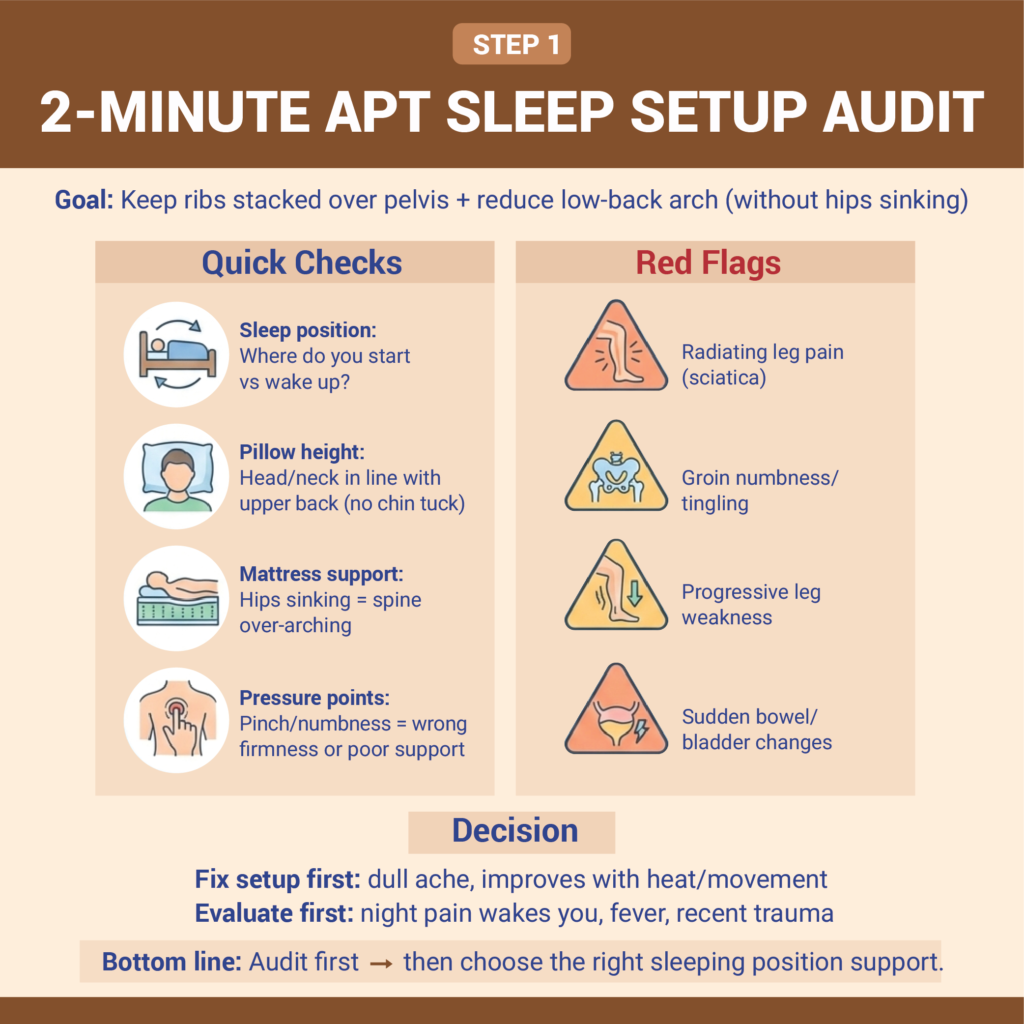
Step 1: Anterior Pelvic Tilt Sleep Setup Check (2-Minute Audit)
When sleeping with APT, the forward rotation of your pelvis makes it difficult for your core to stay engaged during the night. That is why you need the right setup that keeps your ribs stacked directly over your pelvis. It must also reduce arch in your back without sinking your hips.
Evaluate Your Current Setup
Sleep Position
Notice how you sleep and the position you wake up in the morning. If you sleep on your back at night but wake up in a half-stomach position with twisted back, you need the right support. Your current setup is uncomfortable, overall harming your pelvic symmetry.
Pillow Height
Your pillow must have an ideal height that keeps your head and neck in a straight line with your upper back. A too-high pillow will tuck your chin and can indirectly increase the arch in your lower back.
Mattress Support
When sleeping at night, focus on your hip area. If your mattress is too soft, your heavy pelvic zone will dip into the middle of the bed. Further, this will pull your spine into unnatural extension, triggering the tension in your hip flexors.
Pressure Point
Notice the areas of your body that feel pinched or numb. If you keep tossing and turning each night, it can be due to the mattress’s firmness being unsuitable for your body weight.
Rule Out Serious Symptoms
See if you experience:
- Radiating leg pain (sciatica)
- Numbness or tingling in the groin
- Progressive leg weakness
- Sudden bowel/bladder changes
These symptoms indicate conditions like cauda equina syndrome, which must be evaluated by a medical professional.
Fix Setup vs. Get Evaluated
- Fix Setup First: If your pain is a dull ache that improves with movement or heat.
- Get Evaluated First: If you have night pain that wakes you up, a fever, or a history of recent trauma.
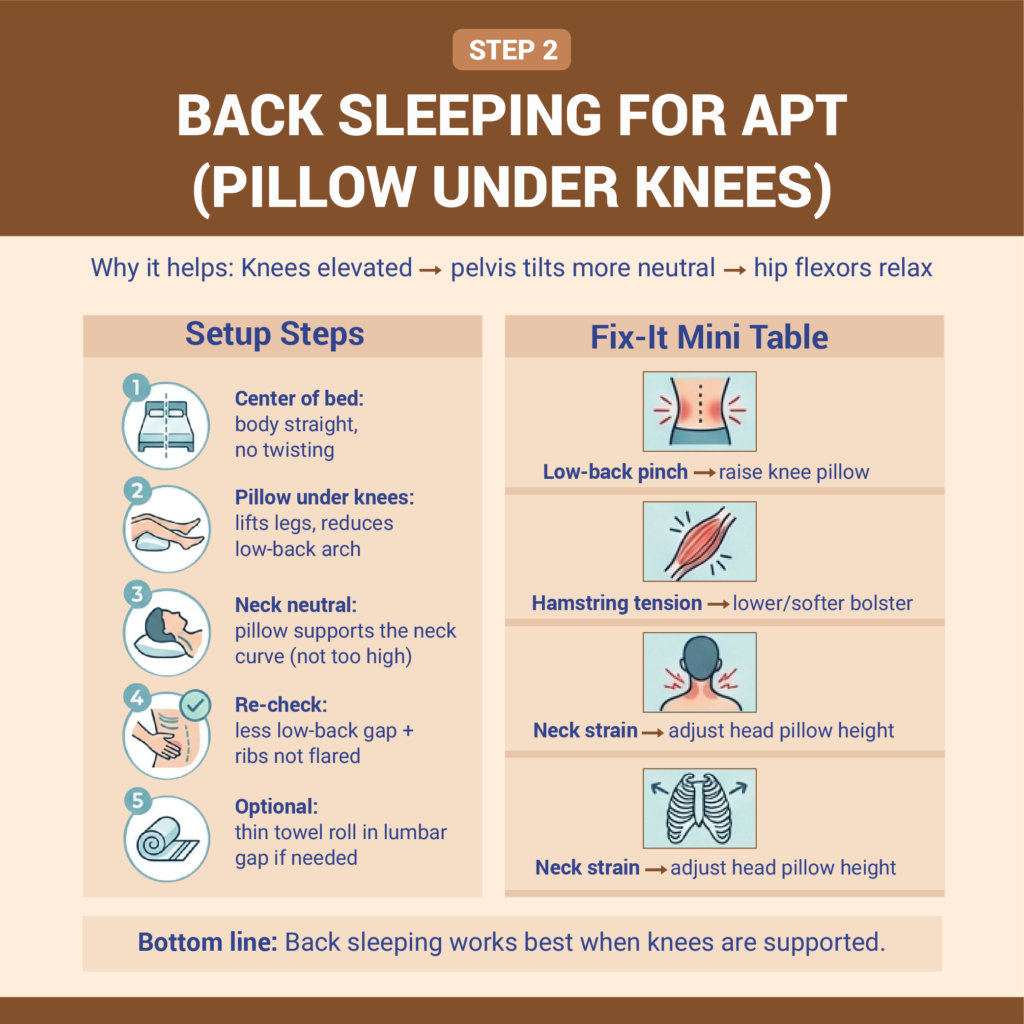
Step 2: How To Sleep With Anterior Pelvic Tilt On Your Back (Pillow Under Knees)
Most experts suggest sleeping on your back for pain relief as it utilizes gravity to keep you in a neutral posture. However, it only works effectively with the right support that releases tension in the anterior (front) hip muscles. Hence, you must use a pillow under your knees to relax the iliopsoas and rectus femoris muscles.
Create a supine-friendly setup with these steps:
- Settle Down: Get on your back in the center of the bed to keep your body in a straight line.
- Knee Support: Slide a pillow or a firm bolster under your knees. By lifting your knees, you tilt your pelvis backward for the neutral spine.
- Neck Alignment: To keep your cervical spine neutral, your head pillow must support the curve of your neck.
- Final Re-Check: Slide your hands under your back, and check if your lower back feels supported against the mattress with reduced gap. Moreover, your ribs should not be flared upward with less pull on your hips.
- Additional Support: If you still notice a slight gap, roll a thin towel and add it to the lumbar space.
Many medical studies say that using a medium mattress firmness for back sleeping gives the ideal spinal alignment. However, if you still find it uncomfortable, you can consider building a supportive setup with side sleeping mattress options.
Back sleeping fixes
| Problem | Adjustment |
| Low-back pinch | Increase the height of the pillow under the knees. |
| Hamstring tension | Use a softer or lower bolster to reduce the stretch on the back of the legs. |
| Neck strain | Adjust your pillow height to keep your chin in a neutral position. |
| Ribs still flared | Focus on a long exhale to engage the transverse abdominis. |
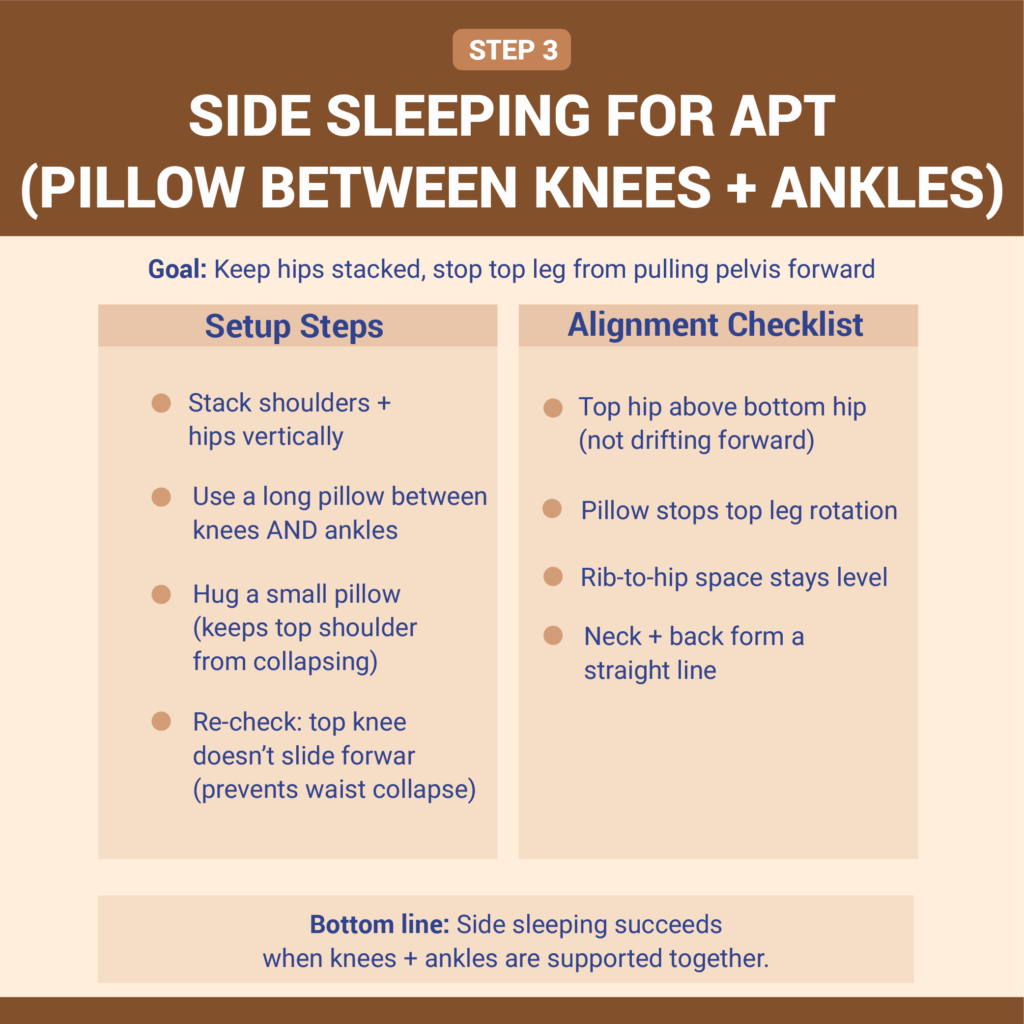
Step 3: How To Sleep With Anterior Pelvic Tilt On Your Side (Pillow Between Knees and Ankles)
If you prefer sleeping on your side, you must aim to maintain pelvic alignment. For this, make sure your hips are stacked to keep the top leg from rotating the spine forward. This also helps reduce the overall strain on your lower back.
To create a side-sleeping setup, follow these steps:
- Stack Your Body: When sleeping on your side, keep your shoulders and hips in a vertically stacked posture.
- Pillow Placement: Use a long body pillow between your knees and extend it down to your ankles. This pillow between knees and ankles for anterior pelvic tilt keeps your full body neutrally aligned.
- Upper Body Support: Take a small pillow and hug it against your chest. This keeps your top shoulder from falling outwards.
- Final Re-check: Make sure your upper knee is not sliding forward to prevent your waist from falling towards the bed surface.
A clinical guide recommends the use of a knee pillow to keep your spine from rotating at night. However, if you have hip bursitis or sharp outer-hip pain, avoid putting pressure on the lower hip and use a softer mattress topper.
Side Sleeping Alignment Check
- The top hip must be above the bottom hip, not tilted forward.
- Use a pillow to keep the top leg from pulling on the pelvis.
- The space between your ribs and hips is level with the mattress.
- Your neck and back form a straight line.
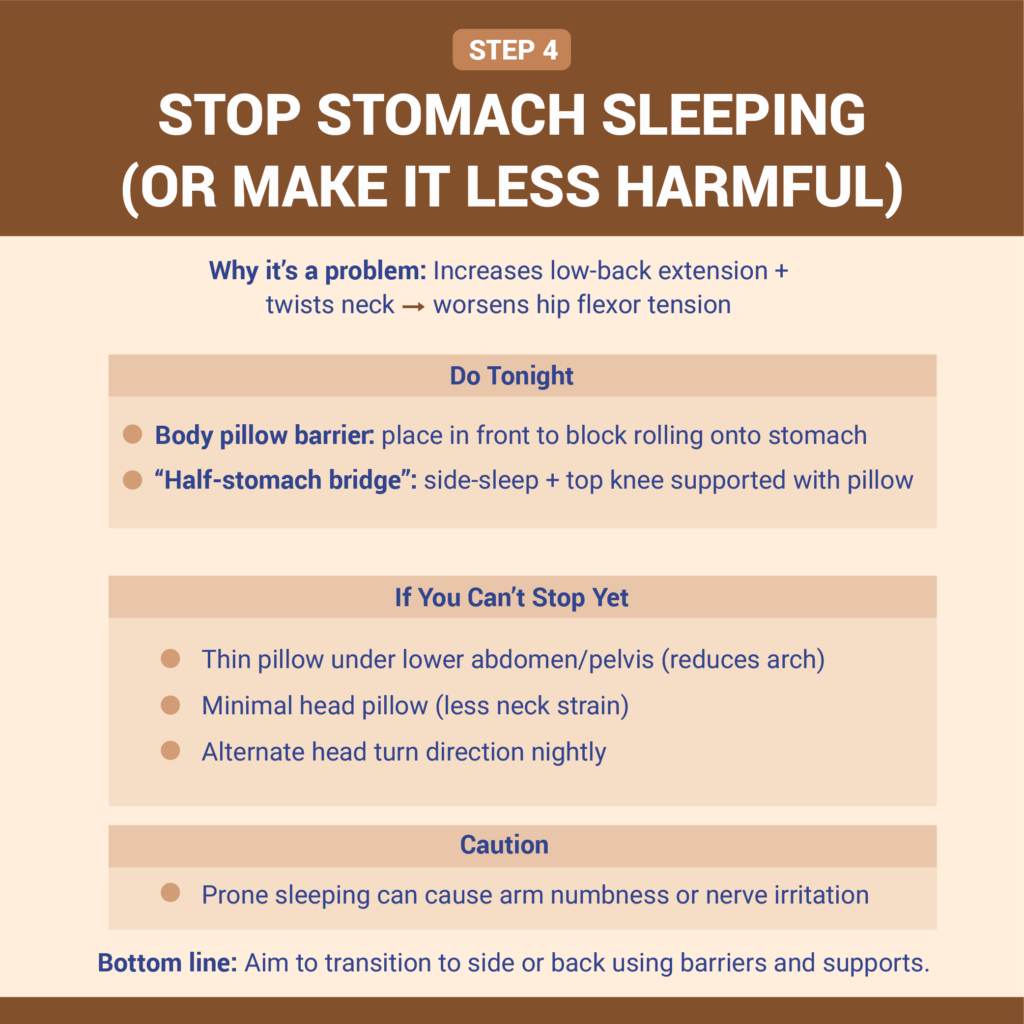
Step 4: How To Stop Stomach Sleeping With Anterior Pelvic Tilt (and What To Do If You Can’t)
Stomach sleeping is often not recommended for those with APT. While it might feel comfortable, it excessively extends the lumbar region and twists the neck into an unnatural curve. This further worsens your hip flexor tightness by compressing the rectus femoris all night.
Make the following changes tonight:
- Use a Body Pillow: Use a body pillow and place it on your front side while sleeping on your side. This will create a barrier to keep you from rolling onto your stomach.
- The “Half-Stomach” Bridge: Try to sleep on your side while lifting your top knee with the help of a pillow. This will feel like you are sleeping face-down but with a better pelvis alignment.
If your sleeping habits are hard to break, utilize these additional supports:
- Pelvic Support: Take a thin pillow and place it under your lower abdomen and pelvis. This lifts the hips while keeping your lower back arch flat when you sleep.
- Minimal Head Loft: Use the thinnest head pillow or avoid using it completely to reduce the strain and neck pain.
- Alternate Head Turns: Each night, alternate the direction of your face to prevent any muscle tension.
The prone sleeping position can lead to arm numbness or aggravate your painful symptoms as it compresses the nerve in your neck. Therefore, you must aim to break this sleeping habit and gradually move towards sleeping on your back or side.
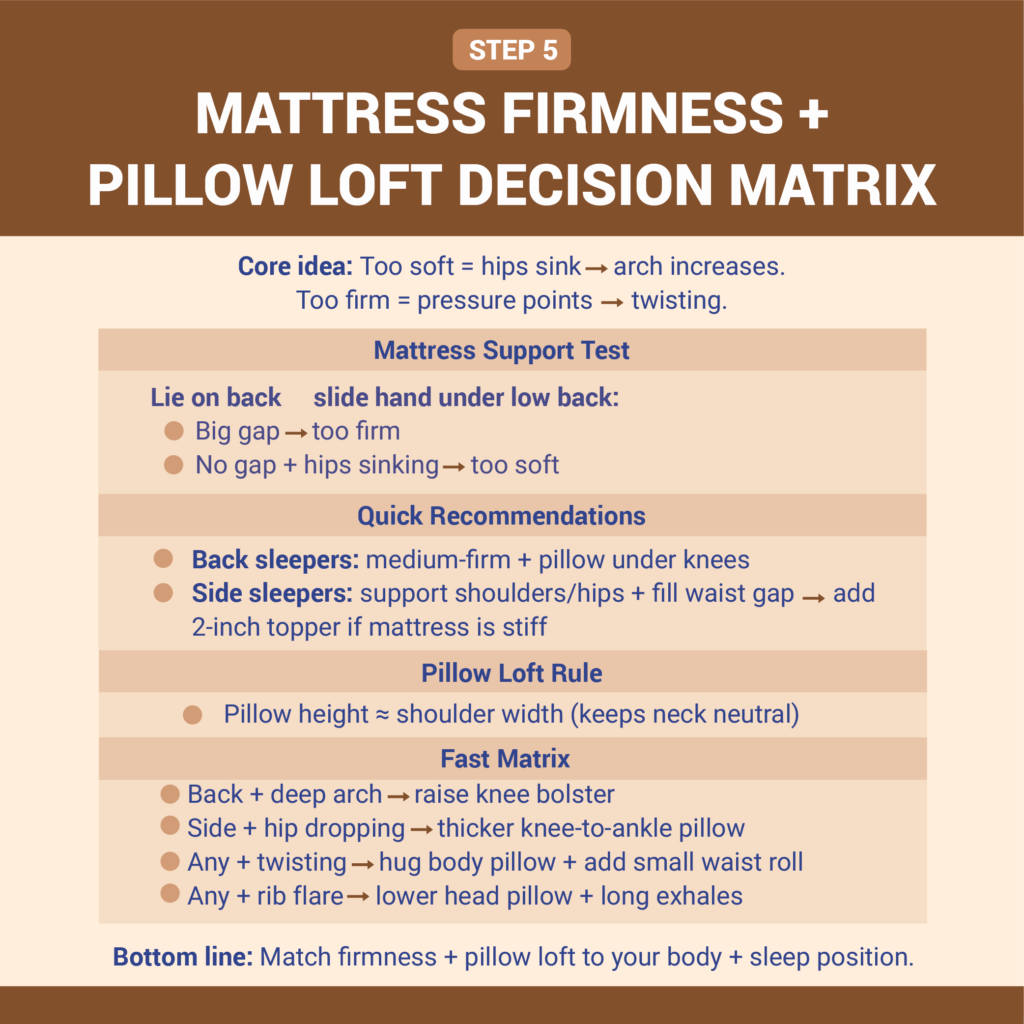
Step 5: Best Mattress Firmness and Pillow Loft For Anterior Pelvic Tilt (Quick Decision Matrix)
Your sleep surface is the first thing that impacts your overall sleep quality and your body’s alignment. To find the best mattress firmness for anterior pelvic tilt and back pain, you must understand which surface will be suitable for your body weight. A soft mattress may be ideal for light sleepers, but unsuitable for heavy people, as it may sink their hips lower than the ribcage. Moreover, a very firm mattress may create pressure points that may result in your body twisting into an uncomfortable curve.
Consider these tips:
Mattress Support Test
Get flat on your back and slide your hand under your back. If you notice a gap, your mattress may be too firm. In contrast, if you notice no gap and sinkage, your mattress may be too soft.
Back Sleepers
Your main focus should be to create a support that does not let your midsection sink. Use a medium-firm surface with a pillow under the knees to get better relief at night.
Side Sleepers
Choose a mattress that supports your shoulders and hips while holding your waist in position. If your current mattress is too stiff, add a 2-inch latex or memory foam topper. This will help fill the gap at the waist.
Check Pillow Height
Make sure that the height of your pillow is according to the width of your shoulder. This will help you keep your spine neutrally aligned all night. A pillow that is too high or too low can lead to morning low back pain.
Research published in The Journal of Social and Health Science recommends a medium-firm mattress to reduce chronic lower back pain. Moreover, you should check your mattress for sagging at least once a year. Try to replace your pillows every 12 to 24 months. Maintain a sleep journal to note your sleep quality for 2-3 weeks after making a change.
Sleep System Matrix
| Position | Primary Symptom | Quick Fix |
| Back | Deep arch or pinched low back. | Increase the height of your knee bolster. |
| Side | Hip dropping or waist collapsing. | Use a thicker pillow between the knees and ankles. |
| Any | Constant twisting or tossing. | Hug a body pillow and add a small waist support roll. |
| Any | Rib flare or breathing feels shallow. | Switch to a lower head pillow and focus on long exhales. |
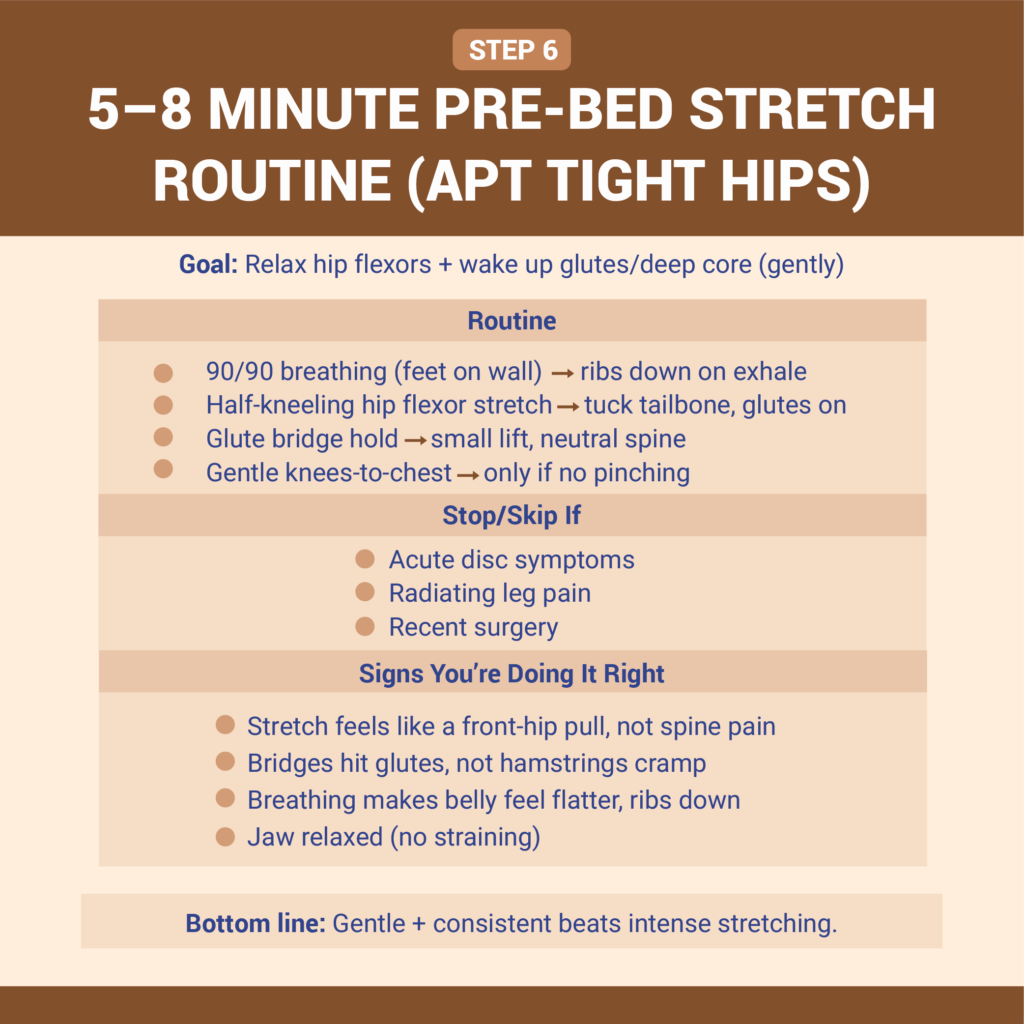
Step 6: Best Stretches Before Bed For Anterior Pelvic Tilt Tight Hips (5-8 Minutes)
Targeted stretches before bed for anterior pelvic tilt tight hip flexors help relax your nervous system and prepare your body for sleep. You must create a gentle mobility routine to target the iliopsoas, rectus femoris, and deep core. This helps reduce the strain on your spine and loosen your core muscles when you sleep.
You can follow this 5-minute routine each night:
- 90/90 Breathing: Get on your back and place your feet flat on a wall and your knees at 90 degrees. Bring your ribs down by exhaling, engaging the transverse abdominis.
- Half-Kneeling Hip Flexor Stretch: Get down on your one knee and tuck your tailbone by engaging your glutes. Do not lean too forward. Instead, aim to tuck your spine to feel a deep stretch in the front of the hip.
- Glute Bridge Hold: While lying on your back, elevate your hips for a few inches. Aim to get the glute activation while keeping your spine neutral when you hold the pose.
- Gentle Knees-to-Chest: Get into a fetal position and hug your knees to your chest. Avoid doing it if you feel any sharp pain or pinching.
All these mobility stretches are considered safe. However, avoid them if you have acute disc symptoms, radiating leg pain, or are recovering from recent surgery.
Here are a few signs that indicate these movements are working for you:
- Front Hip Stretch: You will feel a slight pull in your legs without any pain in the spine.
- Glutes Working: When doing bridges, the back of your hips will feel tight. Avoid if your hamstrings cramp.
- Core engagement: During diaphragmatic breathing, your stomach will feel flat.
- Relaxed Jaw: If you notice your jaw is clenched tightly, this means you are stretching too much.
Maintain an anterior pelvic tilt, sleep troubleshooting, and morning back pain log every day to see which stretches and setup changes provide relief.
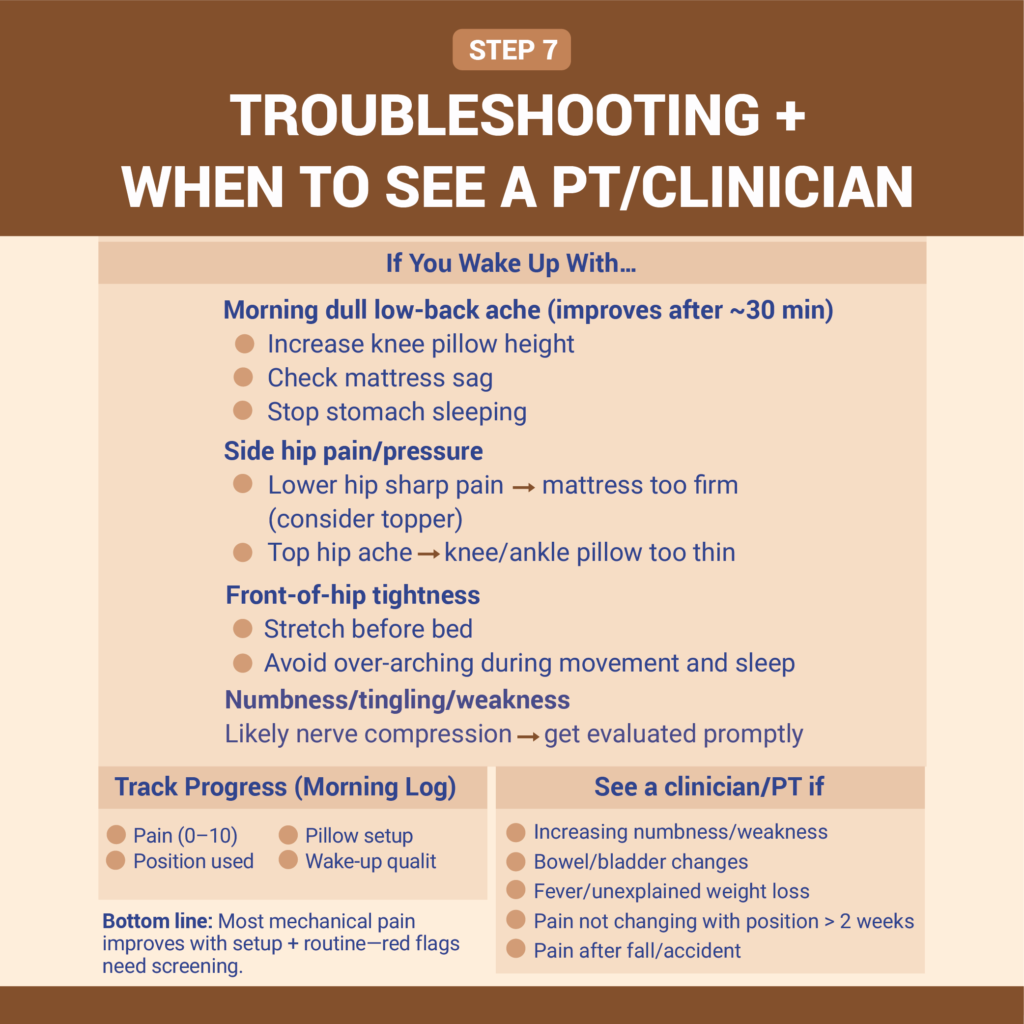
Step 7: Anterior Pelvic Tilt Sleep Troubleshooting (Morning Back Pain, Hip Pain, When To See a PT)
Despite making all the lifestyle changes, if you still experience no improvement in discomfort, you must consider a few extra adjustments:
Morning Low-Back Ache
In the morning, if you notice a dull pain that goes away after half an hour of movement, this may be due to lumbar lordosis during the night. To combat this, increase the pillow loft under your knees. Next, check your mattress sag and stop sleeping on your stomach.
Side Hip Pain or Pressure
When sleeping on your side, if you experience sharp pain in your lower hip, this means your mattress is too firm. Conversely, faint pain in the top portion of the hip shows that the pillow loft between your knees and ankles is too thin.
Front-of-Hip Tightness
If you wake up with a slight muscle pull, it may be because your hip flexors were tight while you were sleeping. To minimize this, regularly stretch before bed and avoid over-arching your back when doing such movements.
Numbness, Tingling, or Weakness
If you notice the sensation of pins and needles in your legs or loss of strength, this is due to nerve compression. For this, get an immediate professional evaluation to eliminate any serious spinal issues.
By following all the best practices consistently, you will see improvements in sleep quality within 1 to 3 weeks. At the same time, comfort in lower back pain may take up to 2 to 4 weeks.
To monitor your progress, keep a simple morning log:
- Pain Level (0-10)
- Sleep Position Used
- Pillow Setup
- Wake-up Quality
See a Clinician Or Pt If You Notice:
- Increasing numbness, tingling, or weakness in one or both legs.
- Any sudden loss of bowel or bladder control or difficulty with these functions.
- Fever or unexplained weight loss are signs of systemic issues.
- Pain that does not change with position or prevents you from performing daily activities for more than 2 weeks.
- If your pain started after a fall or accident.
The National Institute of Neurological Disorders and Stroke mentions that back pain is mostly mechanical and can be managed by changing routine. However, the above mentioned symptoms require immediate professional screening.

Frequently Asked Questions
What is the best sleeping position for an anterior pelvic tilt?
The back sleeping position with a pillow setup under the knees is recommended for those with APT issues. This sleeping posture keeps your lower back flat on the bed surface, reducing the excessive arch. It also makes sure your body remains in a neutral alignment by relaxing your hip flexors.
Is it better to sleep on your back or side with an anterior pelvic tilt?
The ideal anterior pelvic tilt sleeping position is the back sleeping position, as it helps align your pelvis in a straight line. However, if you find it difficult to get into this position, you can sleep on your side with a pillow between your knees and ankles. This keeps your pelvis from rotating when your body is on one side.
Where should I put a pillow for an anterior pelvic tilt while sleeping?
When sleeping on your back, slide a pillow under knees for anterior pelvic tilt. This decreases the overall pull on the iliopsoas and rectus femoris. If you are a side sleeper, take the pillow and place it between your knees and ankles to keep your hips stacked. As a stomach sleeper, use a thin pillow under your lower abdomen to reduce lumbar lordosis.
Can a soft mattress make anterior pelvic tilt worse at night?
Yes, using a soft mattress means your heavy pelvic area may drop deeper than your ribcage. This further forces your spine into an excessive arch. Hence, invest in a medium-firm mattress to get the best support and neutral alignment of the pelvis.
How long does it take to feel relief after changing sleep posture?
You may notice an initial improvement in comfort within 1 to 3 weeks of making changes to your bed setup. However, to see a noticeable reduction in morning back pain, it may take up to 2 to 4 weeks with correct sleeping posture.
What are the most common mistakes when sleeping with an anterior pelvic tilt?
Most APT sufferers use an incorrect pillow height that worsens their back pain in the morning. A high pillow causes the ribs to flare upwards, over-arching the spine. Another common mistake is ignoring the ankle support when sleeping on one’s side, which leads to nighttime discomfort. Many skip the pre-bed stretches, which can help loosen hip flexors at night.
When should I see a physical therapist for anterior pelvic tilt and back pain?
If you notice a sudden radiating leg pain, numbness/weakness, or inability to grab objects, get evaluated for nerve issues. Moreover, if your lifestyle changes show no improvement for at least 2 weeks, seek help from a physical therapist to get targeted treatment.
Conclusion
To learn how to sleep with anterior pelvic tilt, begin with a two-minute evaluation of your current sleep setup. Check if back sleeping position or sleeping on your side gives you the best comfort. Once you choose one position, add extra pillow support under your knees or between your knees and ankles to minimize strain on your lower back.
From there, check if your current mattress is sagging, and see if its firmness is ideal for your bodyweight. Fine-tune the surface by adding a medium-firm topper and adjusting the height of your pillow according to your shoulder width. Finally, follow a bedtime mobility routine to relax your core muscles and maintain a journal to track your daily improvement.
These small changes make sure your pelvis and spine stay in a neutral alignment to prevent lumbar lordosis. However, if your discomfort persists despite following these adjustments, seek the help of a physical therapist to get specialized guidance for your long-term spinal health.