




When you purchase through our links, we may earn a commission at no extra cost to you. As an Amazon Associate, DreamSlumber earns from qualifying purchases. Learn more.
To manage your shoulder pain while sleeping, start by choosing a back or less painful side sleeping position. Then, use a pillow support for shoulder and arm alignment so that joints remain neutral and uncompressed. Next, create a calming pre-bed routine with low-intensity mobility exercises or heat therapy to reduce inflammation. Despite following these steps, if you see symptoms of worsening pain, weakness, or numbness, consult a medical professional. This will help you rule out conditions like a tear or frozen shoulder.
Waking up every time you roll over is exhausting, especially when a sharp pinch in your shoulder feels like it is stealing your rest. Chances are, you are already researching how to sleep with shoulder pain to get the recovery your body needs. This nocturnal frustration is common and may stem from poor side sleeping habits and a lack of proper pillow support for your limbs.
The anatomy of the shoulder is very intricate, which includes the rotator cuff, fluid-filled bursa, and the joint capsule. These are sensitive to the mechanical stress caused by compression and poor alignment. When arms are not supported at night, inflammation can flare up, aggravating conditions like bursitis. This makes it nearly impossible to rest without a specific ergonomic plan. By following a framework inspired by physical therapy, this guide provides a step-by-step approach to achieving comfort. So, scroll down to learn how to protect your joints and when it is time to seek professional medical guidance.

Step 1: Identify the Type and Source of Your Shoulder Pain
The first step to approach your shoulder pain recovery is understanding what type of pain you experience and where you feel it. The shoulder is the most mobile joint in the human body. Therefore, the source of your shoulder pain at night can be from several different structures. Here’s how you can identify where you feel the pain:
- Front of the Shoulder: This can be due to bicep tension or pain in the rotator cuff. This type of pain may feel worse when your arms reach overhead.
- Top of the Shoulder: If the location of the pain is at the top of the joint, it may involve the AC (Acromioclavicular) joint. This feels like a sharp point of pain.
- Deep Within the Joint: This type of pain manifests as a deep and radiating ache inside the bone. This is a sign of osteoarthritis or bursitis, shoulder pain at night.
- Radiating Down the Arm: If you feel pain in your upper arm during sleep that travels down toward the elbow or hand, it may indicate shoulder nerve pain at night or a pinched nerve in the neck.
Once you are able to pinpoint the location of your pain, try to understand its intensity, such as:
- Sharp or Pinching Pain: This may happen if your shoulder tissues get compressed during movement when your arms are raised for long hours while sleeping. It is common with shoulder impingement, as the tendons are pinched inside the joint space.
- Dull and Persistent Ache: If you feel a constant pain accompanied by a heavy feeling, it may be due to rotator cuff strain or inflammation in the shoulder. This is a common cause of shoulder pain worse at night when sleeping.
- Intense Stiffness: If you experience shoulder stiffness each morning and find it difficult to move your arm, it may be due to frozen shoulder (adhesive capsulitis) issues.
- Numbness or Tingling: These pins and needles sensations are due to nerve compression triggered by side sleeping shoulder pain. If you sleep with your arm tucked, it may worsen the pain.
- Deep and Throbbing Nighttime Pain: If you experience this every night, it can be due to bursitis. In this, the small fluid-filled sacs that cushion the joint become irritated. This leads to pain and shoulder inflammation when sleeping on the affected side.
Step 2: Choose the Best Sleep Position for Shoulder Pain
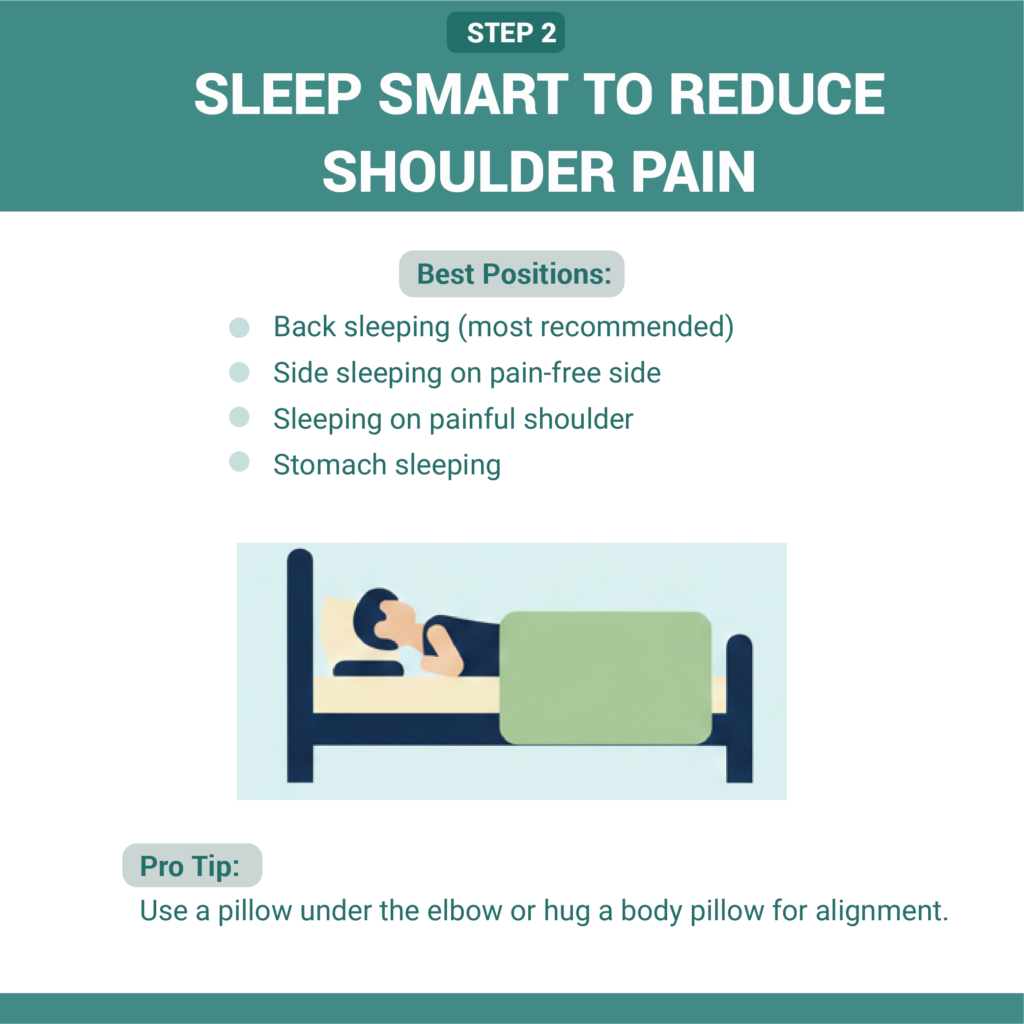
If you have shoulder pain, the best way to sleep is on your back or on the opposite, pain-free side. These positions reduce pressure on the shoulder joint and help keep the neck and spine aligned. Moreover, you should also figure out the pattern and cause of your shoulder pain, and then try these positions:
Back Sleeping
Most experts regard it as the best sleeping position for shoulder pain because it distributes your body weight evenly. Moreover, it also prevents the shoulder from collapsing forward. If you want enhanced relief, use a thin pillow support under your affected elbow to keep the joint properly aligned.
Side Sleeping on Non-painful Shoulder
To sleep on your side, sleep on the healthy shoulder, which is less painful. At the same time, also make sure the other painful side does not droop across your chest and does not strain your rotator cuff. You can hug a body pillow shoulder support for maintaining neutral alignment.
Side Sleeping On the Painful Shoulder
This position must be avoided as it can be very damaging. It directly impacts your shoulder by compressing the joints and restricting the blood circulation to the injured tissues. If you continuously sleep on this side, the minor soreness may become chronic shoulder pain sleep issue over time.
Therefore, you must choose a suitable and neutral position to enhance blood flow to your tissues and reduce the overall mechanical stress while sleeping.
| Sleep Position | Shoulder Joint Stress | Recommendation |
| Back Sleeping | Low | – Highly Recommended. – Use a pillow under the elbow for extra support. |
| Side Sleeping (Good Side) | Moderate | – Recommended. – Use a body pillow to support the top arm. |
| Side Sleeping (Painful Side) | High | – Avoid. – Causes joint compression and worsens inflammation. |
| Stomach Sleeping | High | – Avoid. – Forces the shoulder into internal rotation and strains the neck. |
Step 3: Use Pillows to Support Your Shoulder and Arm Properly
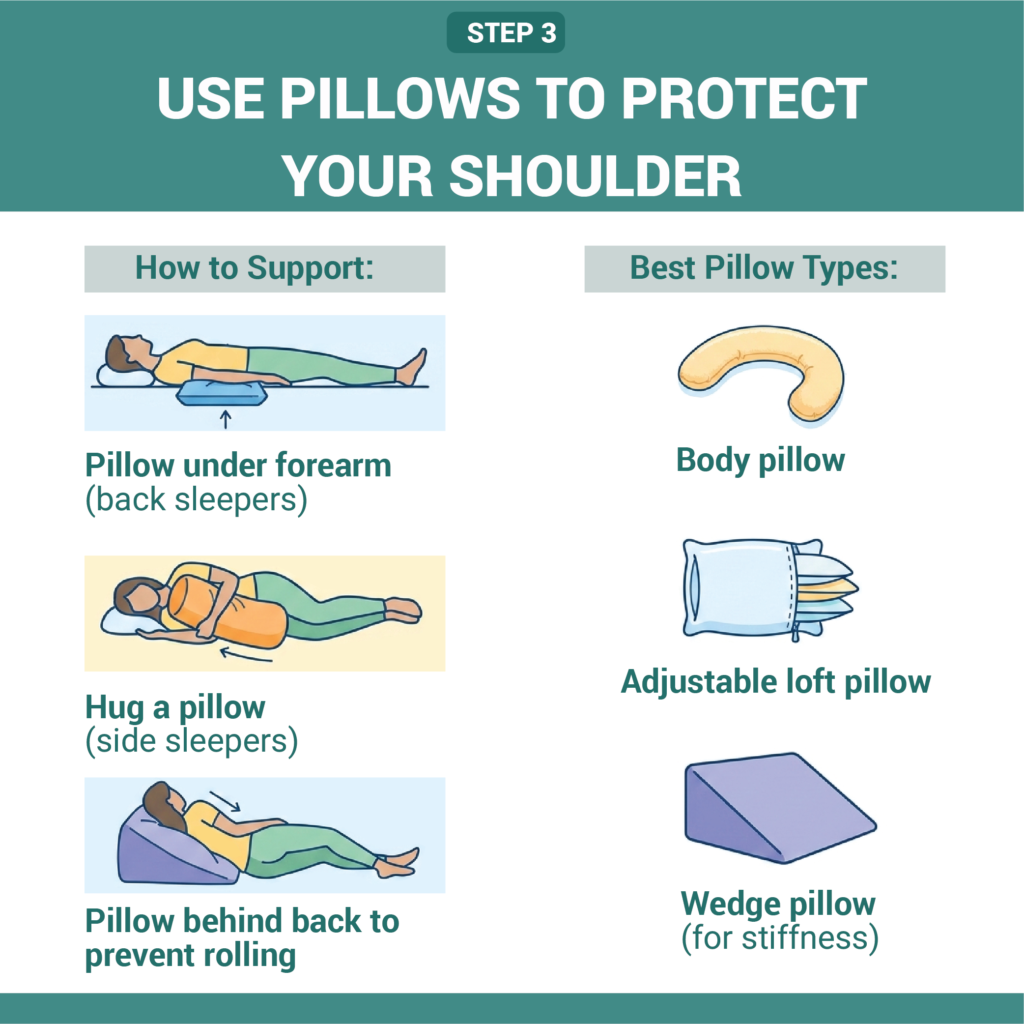
Now that you have found a sleeping position that provides you with relief from pain at night, it is time to understand pillow placement for shoulder pain. The right pillow setup helps you fight the downward pull of gravity and reduce joint strain. Pillows help fill the empty space between your body and the sleep surface, preventing your shoulders from collapsing.
To make sure your legs are supported and muscles are completely relaxed against the weight of your arms, do the following:
Pillow Under the Forearm (Back Sleeping)
When sleeping on your back, use a medium-loft pillow under the arm of your injured shoulder. This lifts the elbow slightly and prevents the shoulder from dropping backwards. This is important for rotator cuff pain sleep management.
Hugging a Pillow (Side sleeping)
When side sleeping, choose the less painful shoulder to sleep on. A thick body pillow can also work as the best pillow for shoulder pain side sleepers as it supports your other shoulder and rests your painful arm on top of it.
Tucking a Pillow Behind the Back
While sleeping, you may accidentally roll onto your painful side. To prevent this, use a firm pillow and keep it along your spine to maintain a healthy sleep posture for shoulder pain throughout the night.
For this support setup, invest in the right accessories, such as:
- Body Pillows: These are long bolster pillows, useful for complete alignment of the body.
- Adjustable Pillows: These pillows come with removable fill so that you can customize the height (loft) as per the width of your shoulders.
- Wedge Pillows: If you experience pain while sleeping flat, you can place a wedge pillow along your spine for inclination. This lets gravity hold the shoulder joint and helps with relief from frozen shoulder.
Step 4: Keep Your Shoulder in a Neutral and Pain-Free Position
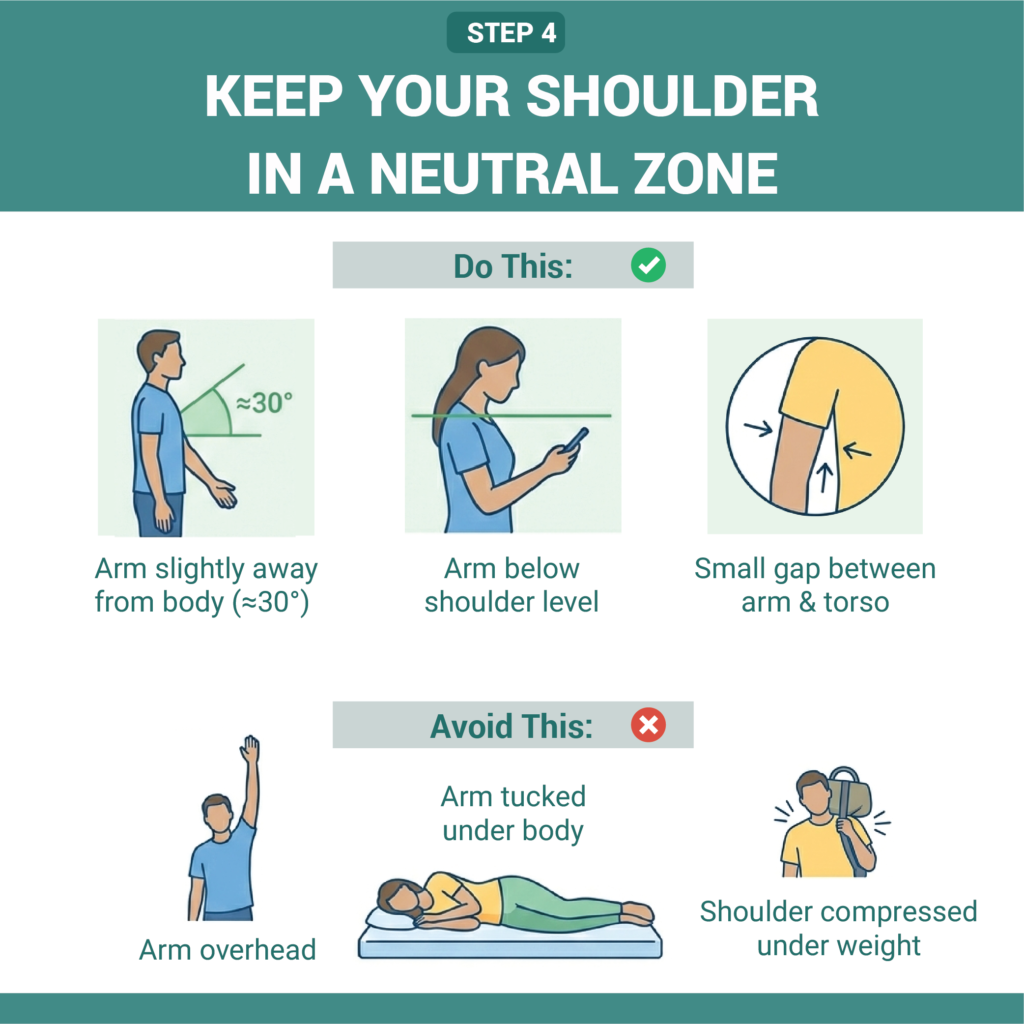
To achieve a neutral position, try to keep your shoulder joint in its place. It must neither be pushed forward, pulled back, nor rotated inward. Finding the right posture helps you reduce the overall mechanical stress on the subacromial space. This also helps you avoid the main cause of shoulder impingement sleep issues. To maintain this alignment, you can follow these tips:
Keep The Arm Slightly Away From The Body
If you pin your arm tightly against your ribs or tuck it under your torso, it restricts blood flow and increases shoulder joint pain. Hence, try to get into a scapular plane position. In this, the arm rests about 30 degrees away from your side.
Avoid Reaching Overhead
When you sleep with your arm stretched above your head or keep it under the pillow, it may lead to upper arm pain while sleeping. This narrows the space in your shoulder joint and pinches the tendons, giving sharp pain.
Use Blocking Tools
If your arm is prone to falling into painful angles while sleeping, keep a rolled-up towel to block those movements. You can also place a small towel under the armpit to make space between your torso and prevent joints from pinching at night.
Neutral Shoulder Positioning Checklist
- Your ear, shoulder, and hip are aligned in a straight line.
- Your injured arm is supported by a pillow and not hanging freely.
- Your arm is positioned below shoulder level (not overhead).
- There is a small gap between your arm and your torso.
- Your shoulder is not compressed under your own body weight.
Step 5: Optimize Your Mattress and Upper-Body Alignment
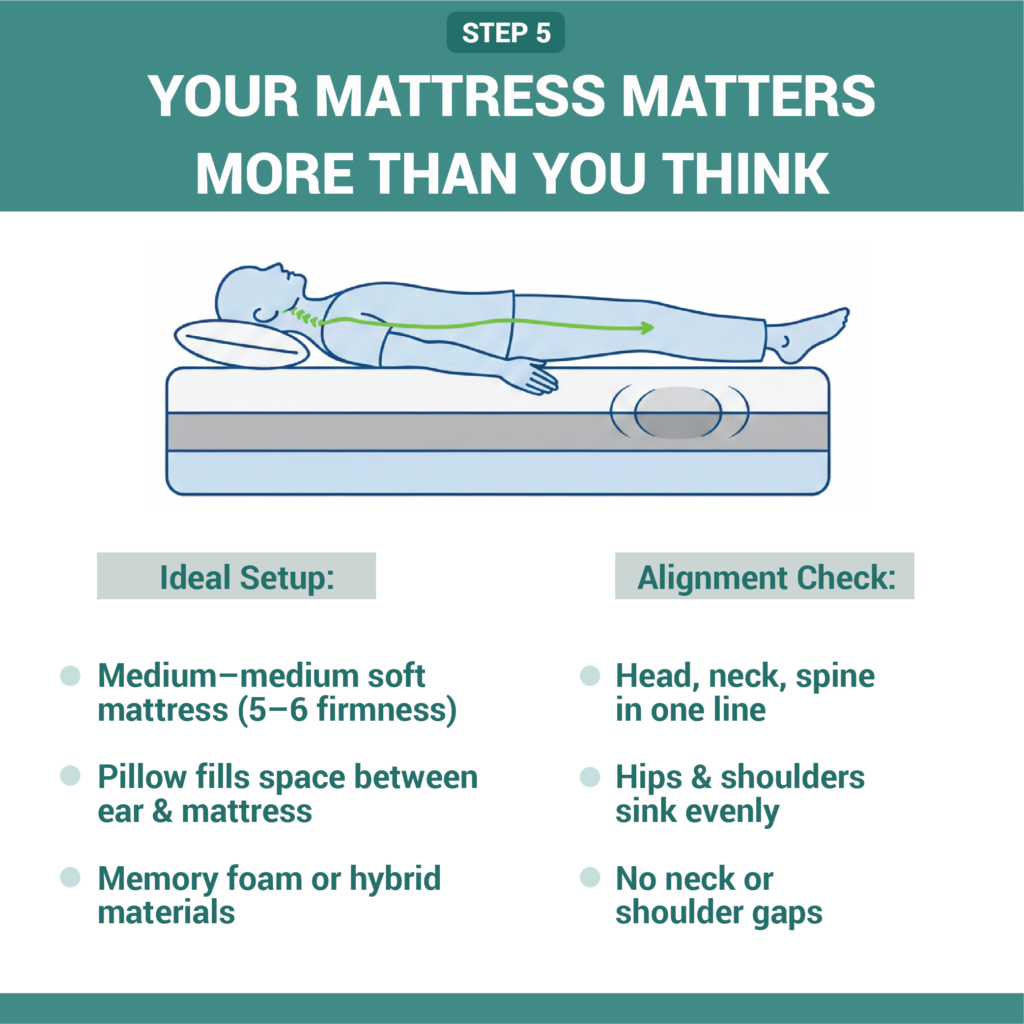
To find the best support for your shoulder pain, you must invest in the right foundation for your sleep sanctuary. For this, opt for a mattress with the right firmness level that does not compress your shoulder joint at night. A too-firm bed will make your shoulder rest on top of the surface, creating pressure points that inflame the rotator cuff. Whereas, a too soft mattress gives minimal support and makes your torso collapse, pinching your shoulders.
Optimize your sleep surface with a suitable mattress and pillow that aligns your head for long-term shoulder pain relief at night. Look for features like:
Medium to Medium-Soft Firmness
For side sleepers, the right mattress must be rated between 5 and 6 on the firmness scale. This mattress firmness for shoulder pain gives you adequate contouring to cradle your pressure points in the shoulder. It also provides overall spinal alignment.
Proper Pillow Height (Loft)
This makes sure your head is lifted enough to fill the space between your ear and the mattress without tilting your head up or down. If you are a side sleeper with broad shoulders, choose a higher pillow (5-7 inches) to prevent the neck from pulling on the shoulder muscles.
Responsive Materials
Your mattress and pillow must be made of high-quality construction and material to give you the appropriate responsiveness. For this, opt for memory foam or hybrid mattresses that respond to your body heat and weight. These distribute pressure more evenly across the joint, reducing upper arm pain while sleeping due to restricted circulation.
Head, Neck, and Shoulder Alignment Checklist
- Your head is level with your spine, not propped too high or sinking too low.
- The mattress contours to your shoulder without pushing back against the joint.
- There is no gap between your neck and the pillow.
- Your hips and shoulders are sinking in at a similar depth to maintain a flat spine.
Step 6: Reduce Inflammation and Muscle Tension Before Bed
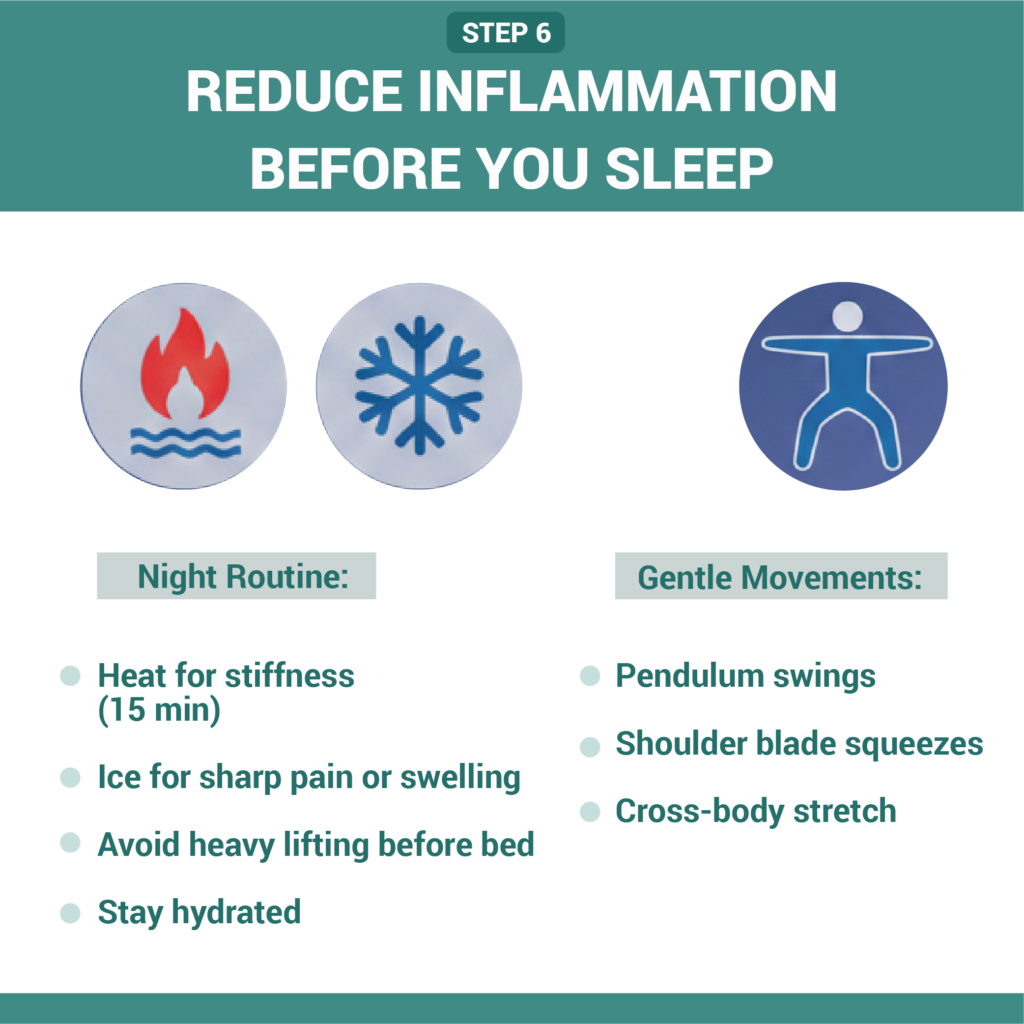
For many people with shoulder inflammation, pain becomes more intense at night. This is because the body’s natural cortisol levels drop, making it feel more prominent. To prevent this, you must create a pre-sleep routine to decompress the joint and soothe the nervous system. Incorporate these habits into your daily life:
Heat vs. Ice Therapy
To relax your tight muscles and increase the flow of blood, place a heating pad for 15 minutes over the affected area. This helps fight the shoulder stiffness in the morning. However, if your pain is sharp or has emerged after an injury, apply ice to the joint to numb the area. This brings down swelling, which helps manage bursitis shoulder pain at night.
Anti-Inflammatory Habits
Make sure you follow a regular waking-up and sleeping schedule. Additionally, avoid lifting anything heavy or engaging in overhead activity at least two hours before bed. Stay hydrated throughout the day to reduce systemic inflammation and avoid caffeine late at night.
Pre-Bed Movements
Before bed, engage in low-intensity exercises and mobility stretches. This helps reset the joints and prevent them from seizing up while you sleep. Only perform a pain-free range of motion to avoid irritating the rotator cuff pain at night.
Step-by-Step Pre-Bed Shoulder Sequence
- Pendulum Swings: Lean forward, supporting yourself on a table with your healthy arm. Let your painful arm hang freely and gently swing it in small circles to create space in the joint.
- Shoulder Blade Squeezes: While sitting upright, pull your shoulder blades together as if trying to hold a pencil between them.
- Cross-Body Stretch: Pull your injured arm across your chest using your healthy hand. Stop immediately if you feel a sharp pinch, as this should feel like a mild release.
Step 7: Adjust Nighttime Habits That Aggravate Shoulder Pain
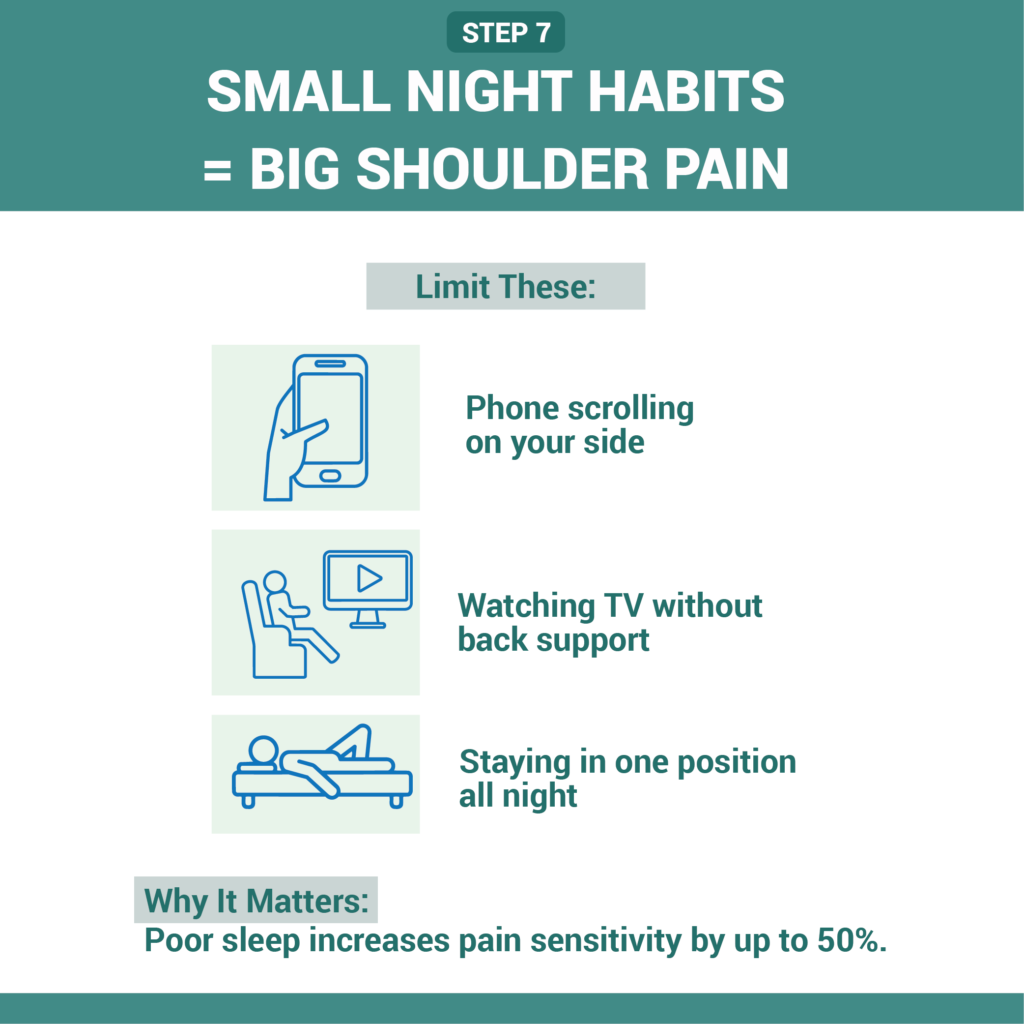
In addition to adding gentle mobility exercises before bed, you need a calming wind-down ritual to help your muscles relax at night. Our joints often suffer from prolonged stress when we stay in a static position for a long time. This creates painful shoulder joint compression and irritates the surrounding tendons. To overcome this and reduce your shoulder pain at night, limit:
Smartphone and Tablet Use
If you have a habit of overusing your smartphone while lying on your side, your top shoulder collapses inward, straining your rotator cuff. Research shows that excessive screen time leads to neck and shoulder stiffness in the morning. This happens due to repetitive micro-strains on the upper limb muscles.
Reading or Watching TV without Support
Avoid reading or watching TV in bed with a thin pillow against your back. This may cause the shoulders to hunch forward, creating a narrowed space in the joint. Moreover, your tendons may get pinched between the bones for hours at a time, leading to impingement.
Maintaining Static Positions
If you notice that you are waking up with a dull ache, make changes to your sleep posture. You can shift from your side to your back to get the blood circulation. Avoid sleeping in the same position through the night and make small shifts to get pain relief.
According to recent research, nearly 50% of individuals with chronic pain report that poor sleep quality increases their perceived pain intensity the next day. This creates a vicious cycle where pain prevents sleep, and lack of sleep makes the pain feel worse. To break this cycle, create consistent habit changes and, occasionally, professional intervention.

Step 8: Track Improvement and Know When to Seek Medical Care
In your quest to find how to sleep with rotator cuff pain or other shoulder pain, you must strive to stay consistent with lifestyle changes. In addition to this, you must also track your improvement and document your sleep patterns. People with minor shoulder pain may feel a difference within a few nights. However, some may take about 1 to 3 weeks for inflammation to improve completely.
To understand the pattern of pain and sleep, you must know the difference between a minor strain and a serious condition. Accordingly, consult an orthopedic specialist or physical therapist if you experience any of the following symptoms:
- Severe Night Pain: If you are unable to fall asleep due to extreme pain and see no improvement even with support.
- Weakness: If you are unable to lift your arm to shoulder height or feel heaviness that makes reaching for objects difficult. This indicates a tear in the rotator cuff.
- Loss of Motion: If you experience a limited range of motion, it may be due to frozen shoulder sleep issues that need physiotherapy.
- Neurological Symptoms: Experiencing numbness and tingling daily from your arms to fingers is a sign of shoulder nerve pain at night or a neck-related issue.
- Systemic Signs: Any visible redness, warm feeling, or swelling along with fever should be treated as an urgent medical concern.
Your shoulder pain may stem from any underlying health issue, and to manage it at home, you can follow a strategy to sleep with arthritis or hypermobility. However, these work more effectively with a professional treatment.

Frequently Asked Questions
Is it better to sleep on your back or side with shoulder pain?
The back sleeping position is considered the best for managing your shoulder pain. This is because it distributes the pressure on the joint while neutrally aligning your spine. Side sleeping shoulder pain can be easily managed if you sleep on your healthier side. Additionally, you can use a body pillow to support your painful side.
Is it bad to sleep on a painful shoulder?
Yes, it is bad to sleep on your painful shoulder as it may compress the affected joint, restricting the blood flow to the tissues. This may further make your minor pain turn into a chronic condition by worsening the inflammation throughout the night.
How to position arm when sleeping with shoulder pain?
The best approach to position your arm while sleeping with shoulder pain is to keep it below the shoulder level and away from the torso. For this, refrain from tucking your arm under your head or pillow, as this position triggers shoulder impingement. To create a gap between your arm and torso, you can place a thin towel in your armpits.
What kind of pillow helps with shoulder pain at night?
To get relief from shoulder pain at night, use a medium-firm contoured pillow for the head, along with a body pillow to hug. With this pillow placement, you make sure your arm is propped up at a comfortable height. This prevents the joint from collapsing and pulling on the rotator cuff tendons.
Can sleeping position make rotator cuff pain worse?
Yes, a wrong sleeping position may worsen your shoulder pain. That is why you must avoid sleeping on your painful side or sleeping with your arms overhead or under the pillow. Instead, either sleep on your back or sleep on your non-painful side to avoid pinching the tendons in the subacromial space.
How long does shoulder pain take to improve with better sleep support?
Many people with minor aches see improvement within a few days. However, for some with severe inflammation, it may take about 1 to 3 weeks to see an actual reduction in pain. To enhance your sleep setup, use a pillow support and a specialized mattress. Create a consistent mobility routine and a wind-down ritual to target faster shoulder recovery.
When is nighttime shoulder pain a sign of a serious problem?
You should seek medical advice if your shoulder pain at night is accompanied by weakness, loss of motion, or pain that radiates down the entire arm. These signs may indicate a tear in the rotator cuff or a frozen shoulder that requires a professional diagnosis from an orthopedic specialist.
Conclusion
To reclaim your nights from persistent pain, it is important to understand that your body heals best when it is supported. To learn how to sleep with shoulder pain, you must follow a holistic approach. The first step is to identify the exact source of your discomfort and link it with the type of pain. After that, choose a comfortable sleep position and stabilize the shoulder joint and rotator cuff with appropriate pillow support. Create a supportive bed setup with a medium-firm mattress and body pillow. Finally, create an effective bedtime routine and follow it consistently to see improvements.
While these adjustments give you relief, look for symptoms or weakness and visit a physical therapist or orthopedic care specialist to get the best advice. Take a moment tonight to reassess your sleep setup. Sometimes, a single pillow adjustment is all it takes to reduce pain and give you a restorative slumber.